
Creature comfort
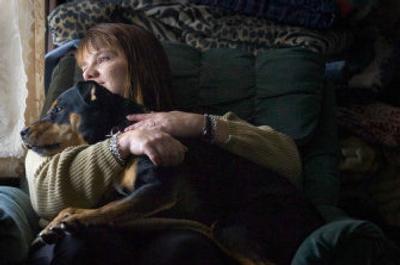
As dog tales go, Kodi’s looked to be short and sad.
The Rottweiler-Doberman cross was clubbed and dropped in a garbage can on Spokane’s North Side as a pup. She lay there in an alley between Jackson and Carlisle avenues bleeding from a gash in her skull until her rescuer, Becca Itterman, noticed blood around the garbage can and decided to take a look.
“I didn’t know what to do,” Itterman said. “He was bleeding. I put him in my coat and took him to Deaconess (Medical Center).”
It was late 2002. Itterman took the dog to the emergency room, where staffers initially thought she had an infant in her coat because Itterman kept calling the animal “baby.” When it became clear Itterman’s baby was a canine, a man at the emergency room drove the woman and pup to the Pet Emergency Clinic on East Mission Avenue, where veterinarians repaired a hole in Kodi’s head.
The dog, mildly brain-damaged, survived. And in her own way, she now returns the favor that saved her life.
Itterman has a bad back. When she’s seated and her spine gives out, Itterman pulls out a thick length of rope and calls for Kodi. The dog latches on and puts its 75 pounds in reverse until Itterman stands.
Training has been difficult for the slow-witted pooch, but Kodi’s “mom” sees the lesson as beneficial for the dog, a sentiment that is broadly shared among professional trainers. All dogs, big, small, Shar-Pei or soup hound, are better off with a job.
“If we had the ability to know what they were good at, and trained them, they could be phenomenal,” said Kristy Ervin, a Lilac City Dog Club trainer who also prepares young canines for the rigors of guide dog school. “A happy dog is a trained dog.”
Yet, dog potential goes largely untapped. Only 11 percent of American dog owners put their pooches to work as furry therapists or physical assistants or doing other labor such as farm work. That statistic, gathered in 2005 by the American Pet Product Manufacturers Association (APPMA), is overshadowed by the 60 percent of dog owners who regard their dogs as furry stress-relievers.
Dogs can do so much more, says Ervin, who tells the story of a shepherd mix rescued from an Idaho animal shelter, to make her point.
Chance, the rescued dog’s name, was recovered by Ervin’s daughter and fellow trainer, Melissa, who had been approached by a family seeking a canine aide for their 6-year-old son, who has cerebral palsy. The boy’s parents wanted an animal capable of bracing their son if he started to fall and also preventing him from leaving their yard.
With heavy doses of good old-fashioned obedience training, Chance learned to stand still when his charge grabbed him for steadying, to bark when the boy started toward the back gate and also to cut off the child’s path.
“Chance went out there and everything went very well,” Ervin said. “Unfortunately, they let him out and he killed their chickens. We found him a nice home in Spokane with a teenage girl who does some obedience training.”
It would have taken a much more disciplined dog, the type extensively trained for service work, to have passed the chicken test. There’s a wide gap between dogs trained to do simple tasks and dogs prepped to guide sight-impaired shoppers through Costco without stopping for a free sample. Itterman contemplated developing Kodi to a very high level of service dog, but the pup was too easily distracted.
“That’s OK,” Itterman said. “None of us are 100 percent.”