
Seahawks fan from afar proves the model of endurance

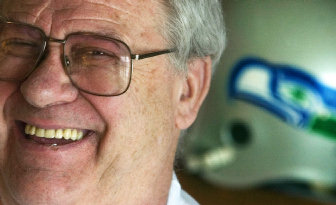
Meet Denny Bewley, Seahawks fan. He has the caps and the T-shirts, the collector’s cards, the football helmet gumball machine.
There is a decade’s worth of score cards on his bedroom bureau – as reference material.
When company comes over, Bewley proudly serves them coffee in his porcelain Seahawks mug. He even has his wife, Phyllis, wearing Seahawks football helmet earrings the week before the big game. The latter is worth noting as Phyllis Bewley is a Seattle Mariners fan, and there is no end to the ribbing she receives for loving a sport like baseball, which rewards a team for knocking the ball out of the field.
What Denny Bewley doesn’t have are ticket stubs to show for an obsession that will span 30 years this fall because Bewley, 62, is an East Side Seahawks fan, the kind that seldom misses the football team’s sweltering summer camps in Cheney, but seldom makes a game.
The entire time that the Spokane Valley resident has followed this Super Bowl-bound team, which is just six years less than his marriage to Phyllis, Bewley has been to only two games.
There are thousands of Seahawks fans like Bewley. Tickets to see the team play are expensive at $55 to $350 each during the regular season. The drive from Bewley’s modest Opportunity home to 67,000-seat Qwest Field is 287 miles.
But Bewley, who works at Napa Auto Parts when he isn’t nursing his football habit, has never missed a game, never been out of place in his stadium of two seats and a sofa when the television picture tube glowed with the radiant green of Seattle’s artificial turf.
Those Sundays could have been wasted hours watching splotches of color changing shape on an electronic box. But Bewley gave those images context by memorizing the story lines of all the great players who strained to reach the summit of success only to be vanquished in the post season.
Until this year, the team has been on a short list of franchises that never made the big game. Bewley has decades of preseason promotional material promising each year would be different, “a new beginning,” “new era,” a “title wave” of change. None of which turned out to be true.
He felt genuinely bad for Steve Largent, a 5-foot-11 wide receiver of only average size and speed who led the league in touchdowns and catches, but never even sniffed a Super Bowl before retiring in 1989. Through the TV, Bewley met Largent in 1976 after the fledgling Seahawks acquired the player before the start of their inaugural season. And Bewley watched as over 13 years the player became a half step too slow and too old at 35 for a young man’s sport.
When Jim Zorn, the team’s first quarterback, took the bench so a young gunslinger, Dave Krieg, could lead the team, Bewley put pen to paper and explained to the elder quarterback that Seattle’s lack of success really wasn’t Zorn’s fault. Zorn had done his best.
“I didn’t spend a lot of time on it,” Bewley now says of the three-page letter, his emotions cooled by the 19 years since his correspondence. “I met Zorn at a practice (years later). I told him about the letter. He said it never got to him.”
Phyllis Bewley, on the other hand, remembers her husband sitting at the dining room table, working on the composition for some time, though now he gives her a suppressive look when she brings it up. When she mentions the “dark years” of the franchise, a time when he was banished to the basement on Sundays because his moods were so foul, Denny Bewley stares at her as if she’s let slip a dark family secret.
In the dark years, the Bewleys’ three children bought their father a “Hawk Block,” a foam brick he would throw at the TV whenever the game soured. His aim often proved worse than the Seattle quarterbacks who were being intercepted.
It was no wonder, then, that when the Seahawks changed their fate Jan. 22 and clinched a trip to the Super Bowl, Bewley was on the edge of his seat waiting for the team’s fortunes to change, even as they took a 20-point lead.
“Seven minutes left, and he’s still saying, ‘They’re going to blow it,’ ” Phyllis Bewley said.
“After they won, the phone rang all night for Denny.”
Denny Bewley got up, walked back to his 2005 season score card and penciled in the score 34-14.
And this time, he punctuated the note with a “W.”