
Launching softball dreams

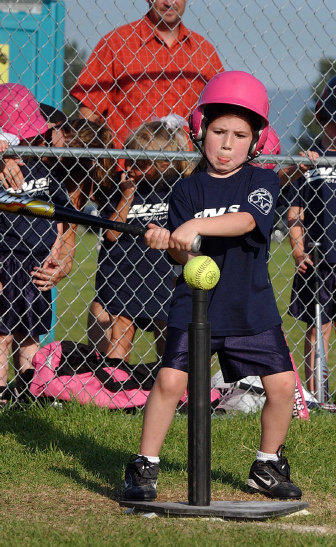
The softball bat says it all.
In bold letters on the hot-pink barrel, where you would expect to see the words “Louisville Slugger,” it says “Girls Rule.”
On a Tuesday night at East Valley Middle School, the Spokane Valley Girls Softball Association is all about girls. On an open space between fields and next to a batting cage, a makeshift softball diamond serves as the launching pad for the softball dreams of two teams made up of 4-, 5- and 6-year-old girls.
This is introductory softball. There is no pitching – fast, slow or modified – and the ball is hit from a tee. No one keeps score, and no one worries about the number of outs. Every player bats in every inning, and every player moves to a different position with each new inning.
The temperature is in the mid-90s at game time, but, with the possible exception of the between-inning spritz from a spray bottle, you can’t tell by looking at the smartly dressed players.
Every player is dressed in a team jersey complete with their name across the back – some with a first name, others with their last. On this night one team wears the maroon of Old Country Buffet while the other sports the navy blue of BNSF Railways.
Each wears matching shorts and socks to complete the ensemble, and most players wear tiny cleated shoes and a visor with the initials “S.V.G.S.A.” printed across the front.
It’s the colored accents that set this game apart.
Half the batters wear bright pink helmets to the plate, and roughly half the players on both teams use gloves of pink and lavender.
“The ones the league furnishes us are over here,” BNSF coach Chris Brummett laughed, nudging an old, stodgy blue batting helmet with his toe. “The cool pink ones the girls buy for themselves.”
Brummett, like his coaching colleagues, keeps track of who has played where and who bats in what order and tackles his role as cheerleader-in-chief with gusto.
“Okay, everybody, Riley is up to bat so everyone cheer for Riley,” he reminds them.
Standing at the plate, a bat in their hands with an oversized helmet atop their head, the players look more like bobble-head dolls than the hard-nosed ballplayers they will soon become.
And you can plainly see that a love for the game has begun to grow.
Take young Sammy, for example. Barely taller than the bat she uses and with a blond pony tail bouncing behind her, the youngster’s smile never leaves the entire game – especially after she ends the game with a bases-clearing home run.
Not that it took a tape-measure shot to accomplish the feat. Every inning finishes with a bases-clearing home run. Every batter hits safely, whether the defense scores an out or not, and every runner returns home. The batting order, like the defensive assignments, changes every inning so a different player homers each half-inning.
On defense, the goal isn’t to make a stunning stab and a great throw. Most of the time fielders treat ground balls the way former big league catcher Bob Uecker caught a knuckleball: “Wait until it stops rolling and pick it up.”
Throws are treated like knuckleballs, as well. Most go a maximum of about 20 feet in the air and then roll the rest of the way to the intended target.
“Anyone who makes a good catch and a good throw gets bubblegum,” Brummett tells his players midway through the game.
And then thinks better of the offer.
“Okay,” he says. “You all get bubblegum. But if you make a good catch and a good throw, you get it sooner.”