
Some modern art really is fishy
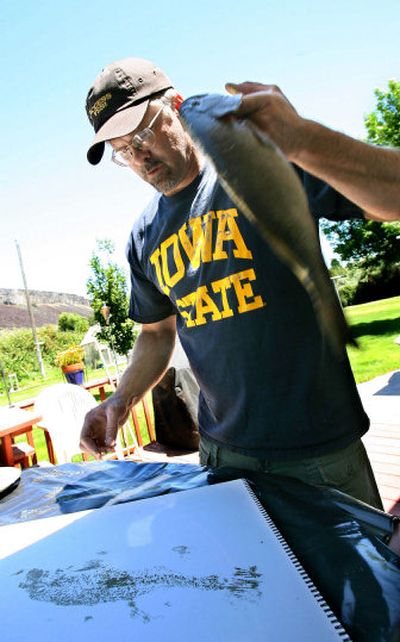
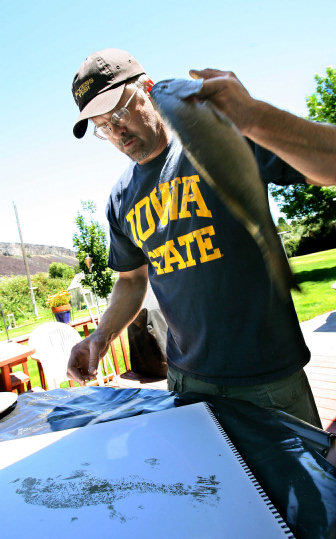
WENDELL, Idaho – When Doug Young gets off work, he walks down a small road to his house, pulls up a table in the backyard and slathers a dead fish with paint.
It’s how he makes art.
Young, who works at the Niagara Springs State Hatchery, and two other members of the Idaho fish hatchery staff create prints of Idaho fish, including sockeye, steelhead and chinook.
Rick Alsager, manager of the Nampa hatchery; Don Baker, manager of the Eagle hatchery; and Young make up Four Sockeye. They dab paint on fish with a sponge, take pressings of their scales and fins and draw in the rest to create realistic images. The pieces incorporate acrylics, watercolors and ink pen.
The three began the paintings in 1989 when they started experimenting with chinook and steelhead at the Sawtooth Hatchery. They took their inspiration from the Japanese form of the art known as “gyotaku.”
“Everybody at the hatchery got one,” Young said of those first prints.
Young moved to the Oxbow Hatchery near Hells Canyon in 1990, but left his paint behind. The following year, only four sockeye returned to Redfish Lake. The state hatchery workers moved all four to vats inside the hatchery to keep an eye on them.
That night, one fish laid eggs. The hatchery staff was not prepared for the event and killed a male for his sperm so they could breed the fish. Alsager was on the scene and itching to get a painting.
”(The Fish and Wildlife office) looked at Rick as he was holding the fish and said, ‘You’ve got 15 minutes,’ ” Young said. “We got 12 pages. Six or seven of them disappeared.”
The impressions were eventually turned into the first limited-edition print in 1997, “Redfish Return.” Since then, it has been joined by four others: “Salmon River Rogue,” a chinook; “Spring Fling,” a steelhead; “Fish On,” a white sturgeon and the trio’s only print with a live fish; and “A Cutt Above The Rest,” a cutthroat trout.
All the fish but the cutthroat have one thing in common: They are all listed as either endangered or threatened by the U.S. Fish and Wildlife Service. Young and his compatriots intend to paint all listed Idaho fish, with only the bull trout remaining to be done. The fish are not killed solely for the art, and each fish becomes a set of 350 limited-edition prints that sell for between $70 and $100.
Five percent of their income from the art goes to Idaho Department of Fish and Game’s Nongame Program.
After the bull trout print, Four Sockeye will focus on originals and requests. It’s something Young didn’t expect.
“We didn’t ever think anyone would want originals,” Young said.
Though he is proud of his art, Young said it pales in comparison to the actual fish.
“The power they have is just unbelievable,” he said. “I don’t come close (to capturing it).”