
A family finally made whole
A mother belongs with her son.
Akout Agang feels this as deeply as she feels her own pulse. For eight years, she and her son, Eliow, now 12, have been separated by a civil war in Sudan, as well as by poverty and government red tape.
Now, on this last day, Akout busies herself with a feast, cooking and cleaning in a sweltering Spokane apartment. She arranges piles of injera, a spongy, pancake-like bread. The rich smell of chicken and chili peppers drifts through the living room. The apartment buzzes with nervous energy.
On this night – Thursday, July 6 – Eliow is coming home.
Eliow’s sisters – Akon, 5, Nebol, 4, and Adio, 2 – pester their mother with questions about the brother they have never met.
“They are talking so much,” Akout says, with a weary smile. “All day they ask this: ‘When is my brother coming?’ “
Since they arrived in Spokane in 2003, the family and Eliow have had only occasional phone calls to Sudan. So often, those calls ended in tears.
The boy would ask in Dinka, Did you forget about me?
And the mother would answer, No, son. We are doing everything we can.
If Eliow didn’t trust her words, there was no doubting her tears.
Separated by war
Civil war in Sudan scattered the family in the 1990s, and Akout and her husband, Georges Eliow, fled to Lebanon. Akout walked for two weeks across Sudan to join her husband in Beirut, where Akon and Nebol were born. But the trip was too dangerous for a toddler, who might succumb to the heat or be stolen and sold into slavery, the family decided.
So Eliow stayed behind. Now, the boy is both a son and a stranger. The most recent photo, kept in a place of honor in the living room, shows a boy on the verge of manhood.
“I can remember him, but he was very little,” Akout says quietly. “He’s grown up now.”
In the intervening years, Georges, the son of a tribal chief in the Nile basin, and Akout learned how to drive a car and operate microwaves. They joined a Christian church and worked hard at jobs that barely paid the bills. They celebrated the birth of a daughter, Adio, now 2, who babbles in English.
A world away, Eliow and his grandmother moved to a windowless shack in the northern Sudanese city of Khartoum to live with other Dinka tribesmen displaced by the conflict. The boy had no access to school, and he spent the days, then the years, at the little shack with earthen floors and a roof of cardboard and plastic.
A thousand small things conspired to keep the family apart. Born in rural Sudan, Eliow had no birth certificate. His parents submitted to DNA tests to prove he was their son. The results got lost. The Sudanese government “irrevocably closed” Eliow’s emigration case.
Eliow didn’t qualify as a refugee because he had never left his native country. His parents aren’t yet U.S. citizens so they were unable to return to Sudan, which has limited U.S. consular services, to pick up their son.
In Spokane, community support kept the frustrated family afloat.
Their church, Valley Fourth Memorial, raised thousands of dollars to help reunite the family. Jack Lewis, who teaches at Moody Bible Institute, and his wife, Cheryl, traveled to Khartoum for a pastor’s conference and visited the boy.
Finally, this month, the family received word that Eliow would fly to Spokane on July 6. His father, Georges, traveled to New York to meet the boy on Thursday and fly the final leg to Spokane.
Father and son had not seen each other in a decade.
I want to go to my home, Eliow told his father.
Reunion
On Thursday night, Akout organizes a slew of friends, family and rambunctious children. To complicate the night, it is Nebol’s fourth birthday. The family tells her that Eliow is her birthday gift.
At just after 9 p.m., dozens of people tumble from the apartment to cars waiting below. A caravan of five vehicles, packed with balloons and flowers, meanders to the airport, only to discover that Eliow’s flight is 26 minutes late.
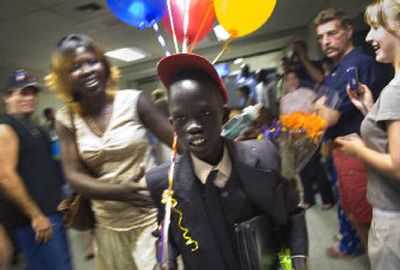
The mob of people transforms the airport into a party atmosphere. Perhaps 50 people have arrived to meet the boy.
“It is amazing to see God’s hand at work,” one church member says.
Children race up and down the stairs, dodging between parents’ legs and mugging for cameras. Little Adio drags a bundle of purple irises across the floor.
Akout carries a bouquet of orange flowers, alternately scooping up her youngest daughter and scanning the hallway, waiting for the doors to slide open.
At 10:30, a security guard opens the glass doors, which disgorge weary business travelers with laptops slung across their shoulders and students with bulging backpacks.
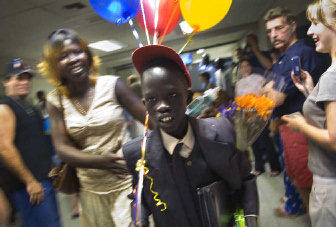
From amid the crowd there emerges a slight boy in a neat gray suit jacket and a red ball cap.
Akout rushes forward, her hands to her mouth, tears beginning. A security guard stops her.
“Stay behind the line please,” he says.
The boy shuffles forward, his eyes registering a deep fatigue. And then he sees her, and she sees him, and Akout can’t stay behind the line, can’t wait any longer.
Mother and child throw themselves at each other in an almost violent embrace.
They stay that way for several long seconds. The crowd of cheering well-wishers recedes into the background as Akout and Eliow hold each other.
There have been so many tears for this small boy from Sudan, with his too-big red Nikes and his pressed blue jeans.
Now there are a few more. Akout is powerless to stop them.
But this time, tonight, it is so different. For Eliow and his mother, these tears are so very different.