
Police finalist foresees good fit

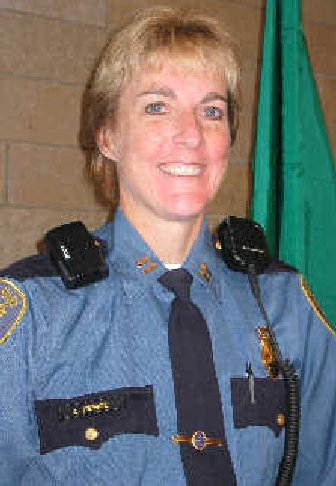
MAPLE VALLEY – In 25 years on the Seattle Police Department, Assistant Chief Linda Pierce has covered a lot of ground.
She’s worked in every precinct in the city. She’s been in charge of the horse team, SWAT team, harbor patrols and the unit that investigates police misconduct. She’s run terrorism drills, cracked down on street violence in Seattle’s downtown bar district and been field commander during riots and a running gun battle with a notorious bank robber.
Now she wants to bring that experience to Spokane as the city’s next police chief. An avid skier, dog sledder and mule rider, she says the Lilac City offers the perfect blend of the professional and personal, of urban amenities and the outdoors.
Pierce, 47, is one of four finalists for the job. City officials will begin interviews next week.
“I haven’t applied anywhere else,” she said in a recent interview at her home, several miles down a dead-end gravel road in rural King County. One way or the other, she said, “Spokane is where we’ll end up.”
Pierce was raised in upstate New York, amid the rolling hills and cow country around Syracuse. Her father was a coach and administrator at Syracuse University; her mother a school librarian. Pierce is the youngest of four siblings.
She chose police work largely because she had neighbors who had brothers who were officers, and she wanted a career with variety.
With policing, she said, “you could pretty much be assured that things would always be different.”
She went to Syracuse, graduating with a criminal justice degree in 1980. After a short stint as a chemical company security guard, she was hired as a patrol officer in Seattle. A rower and ski racer, she wanted to work someplace where she could do both. Moving across the country, she started on the night shift in Seattle’s south precinct, learning the realities of policing on the job: answering disturbances, investigating burglaries, looking for lost children.
In 1985 – while still working full time as a cop – she started law school at Seattle University. She’d start her patrol job at 4 a.m., work until noon, then go home to grab a couple hours of sleep. She’d go to law school in the evenings, sleep a couple more hours, then go back to work.
She did that for three and a half years. Single at the time, she met her future husband in her last semester at law school.
From her earliest years working in Seattle, Pierce has lived in rural King County. Today, she and her husband share a western-style home decorated with fir beams, leather riding tack and Navajo-style blankets. The home is surrounded by pastures, a large barn and a corral.
“I went to their wedding and the best man and bridal party were two cows, three mules and three Rottweilers,” laughed Janice Corbin, a former civilian bureau chief for the Seattle Police Department. “The Rottweilers had on bow ties.”
In an odd coincidence, Pierce took the bar exam sitting next to a fellow police officer named Anne Kirkpatrick. Kirkpatrick, now police chief in Federal Way, is one of the other four finalists for the Spokane chief’s job.
After getting her law degree in 1988, Pierce began a rapid rise up through the ranks in Seattle. She supervised six detectives, then 15 patrol officers, and soon a patrol watch of 70 people.
Pierce says she likes the problem-solving part of the job. She likes finding ways to streamline the work, to draw communities into helping the police. When a rash of shoplifting calls were pulling Seattle cops off the streets, she developed a program where specially trained store security guards could file theft reports directly to a detective. She’s helped write public reports examining how her own department responded to riots at the 1999 World Trade Organization meeting and a Mardi Gras celebration in 2001. She doesn’t sugarcoat things, said her boss, Seattle Police Chief Gil Kerlikowske. She also doesn’t complicate them, Kerlikowske added, and isn’t afraid to recommend changes.
“It’s so critical to be open and willing to say what went well and what didn’t,” said Pierce. “People need to know we’re willing to self-analyze.”
After a dozen assignments, she heads the department’s Criminal Investigations Bureau, a 275-person unit that handles investigations, evidence and major crimes. One of five assistant chiefs, she earns $136,388 a year.
Corbin is the one who tapped Pierce to head up the internal investigations unit, which investigates complaints against police.
“I went to the chiefs and the assistant chiefs and said, ‘This is the one,’ ” Corbin recalled. “She has integrity, perseverance, a commitment to high standards and she’ll listen when she doesn’t know something … I think she was born to be a chief.”
Along the way, Pierce has gained a reputation as a no-nonsense fixer, someone who can make unpopular decisions. One of her earliest assignments as a lieutenant, Corbin said, was to a precinct “which was pretty accustomed to doing what they wanted to do.”
Pierce took command and insisted on more reports, better attendance and more investigation follow-ups by officers. Some changes were so unpopular that officers transferred to other precincts.
“She was asking them to do more work than they’d been accustomed to,” said Corbin. “They didn’t like that. They didn’t want to be challenged by anybody, especially a female lieutenant.”
Especially early in her career, colleagues say, Pierce got a reputation as an abrupt, my-way-or-the-highway boss.
“There’s some criticism out there, but I’d be disappointed if there wasn’t,” said Kerlikowske. “That would tell you that an assistant chief isn’t making decisions, is favoring the guild or some other such thing.”
“Like most of us, she has her supporters and her detractors,” said Seattle Police Guild President Rich O’Neil. “She’s not afraid to make a decision, and sometimes when she does, people will not like the decision she makes. She’s not wishy-washy, I’ll say that.”
Colleagues say that Pierce would also bring an unusual blend of administrative savvy and tactical, street-level police experience to the Spokane job.
She commanded the police units dealing with five days of Iraq war protests in downtown Seattle, as police tried to contend with splinter groups repeatedly breaking off the main protest march. Pierce was the one deciding when to stop the demonstrators and how.
“And it’s all occurring right in front of you,” she said. “It’s not like you can sit back and talk about it” and consult with superiors.
Commanders have to be able to read the tone of their officers’ voices on the radio, to stay calm, to ask the right questions and to be decisive, Pierce said.
In 1996, she was in charge as police got into a shootout with three bank robbers. With 100 police combing a 12-block area, officers finally cornered the third robber in a camper. And in 2001, Pierce was the incident commander during two days of Mardi Gras riots in Seattle, as police tried to disperse a rock- and bottle-throwing crowd of 5,000 people in Pioneer Square.
Pierce said she likes the teamwork and making decisions in a fast-paced environment.
“It’s a great job,” she said. “For the people who do it, it’s a calling.”