
Spokane should rise above water
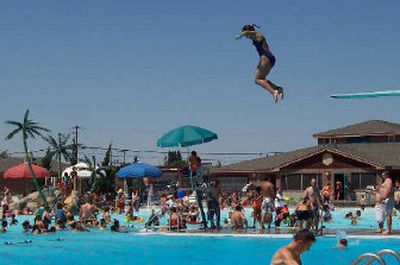
By the late 1980s, the aging municipal pool in Moses Lake was a hole of shame. Its mechanical systems were deteriorating, and one day an edge of the pool fell completely off.
“It was running on duct tape and a prayer,” said Spencer Grigg, the city’s director of parks and recreation.
Another city official traveled to Wisconsin, saw a water park there and said, “This is what we have to build.” Other leaders agreed, but voters turned down their pool bond issue. Schools before pools became one cry of opposition. Others worried it would become a money-chewing white elephant.
City leaders built it anyway, using state recreation grant money and bonds that didn’t require a citizen vote.
The Moses Lake Family Aquatic Center cost $2.9 million and opened in 1994. It’s been a spectacular success. It nets between $30,000 and $75,000 a year and employs about 100 people.
On the Fourth of July, I drove to Moses Lake as part of my summer quest to swim in all rural pools within 90 minutes of Spokane. I’m exploring how smaller communities provide public swimming, because Spokane’s pool situation is in a state of shame.
We have five outdated outdoor pools, and the indoor pool at Shadle Park is slated for demolition. And there’s not a heckuva lot of interest in Spokane’s looming pool crisis, except by swimcionados like me.
If Moses Lake, population 17,000, can build a world-class public water park, what’s our excuse in Spokane, population 200,000? We’re being one-upped by Moses Lake, people, Moses Lake!
I’ll cool down now as I float back to the memory of my day at the Moses Lake marvel. The outdoor facility is open at 11 a.m., every day of the week in the summer. By noon, people were lined up eight-deep to pay admission. I paid my $5.50 (children 4 and older pay $4.50) and walked through ultra-clean changing rooms.
I emerged to behold the Olympic-size pool, the shallow water area with climbing toys and miniature slides, the two diving boards, the two 200-foot water slides and fake palm trees that looked more soothing than silly.
Under the real trees on an expansive lawn area, families were setting up lawn chairs and barbecues. One family hooked up a small satellite dish and television, I kid you not. They watched the World Cup Soccer match while their young ones roared down the water slides a few feet away.
Grigg, who once worked for Spokane’s parks department, said the aquatic facility changed Moses Lake’s pool culture in a dramatic way. Traditional pools, such as the pools in Spokane, are drop-and-drive-aways. Though some adults swim with their children, some parents still use the pools as baby sitters.
Doesn’t happen in Moses Lake. “We see about one adult for every two to three kids,” Grigg said. “We get a family crowd.”
One of those family crowds, the Wambolds of Spokane, discovered the water park nine years ago. Two to three times a summer, the family packs their cooler and treks to Moses Lake.
“From our house to their gate is an hour and 33 minutes. The kids have timed it,” Tina Wambold told me.
Tina’s five children used to swim at A.M. Cannon and Comstock pools, but they stopped two years ago.
“The times are inconvenient and not open on Sunday,” Tina said. “Hello! It’s hot here on Sundays.”
Grigg said that the Moses Lake aquatic park sends this message to its children: “You are just as important as kids all over the world.”
So are Spokane’s kids. Let’s show them by building a Moses Lake-class water park.