
Time to take care of the dead
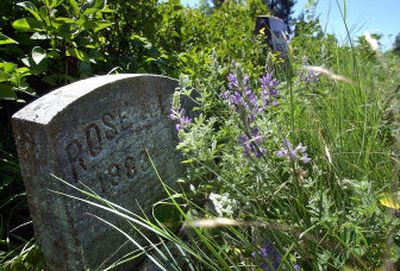
If not for the weather-worn sign off Highway 27, it would be easy to miss the final resting place of some 130 settlers, their families and other people in Mica Cemetery.
The seat of an aging bench sits about level with weeds and wild grain. Many headstones are hard to spot in the foliage, and lichen renders some of the oldest, from the late 1800s, unreadable.
“On a regular basis, nobody takes care of it, really,” said Diane Mabie, who lives nearby.
She’s shooed hunters and teenagers from the grounds. But aside from the efforts of civic and church groups to clean up the place every few years, the 3.2-acre cemetery has been left to the weeds and rampant lilacs.
It hasn’t gone unnoticed though. Every time Wendy Snyder drove by, she said, the cemetery made her sad and disgusted. So much so that Snyder, who lives several miles away in Spokane Valley and doesn’t know anyone buried there, offered to clear the brush and weeds and then take care of it with her family.
“It’s a lot of work but I can’t stand thinking about these people being neglected,” Snyder said.
She’d like to get started this week, if she gets the go-ahead from Spokane County.
In 1969 the Legislature revoked the taxing authority of rural townships, present in only two counties in the state. The 50 or so rural townships in Spokane County were dissolved after a public vote five years later, transferring their community property to the county.
“Many of them were considered county cemeteries after they got rid of the townships,” said Maggie Rail, who’s researched cemeteries in Spokane County and elsewhere.
A book by another local historian lists 61 rural cemeteries in Spokane County and several unmarked grave sites. Some are privately owned and some became the charge of cemetery districts.
At Woodlawn Cemetery in the Edgecliff neighborhood, residents and community groups worked for years to clean up the grounds and persuaded Spokane County to hand over control of it to the Fairmount Memorial Association.
Still others like Mica Cemetery remained the responsibility of the county.
In years past, officials have said Spokane County doesn’t have the money for crews to run or maintain cemeteries.
Across the state, there are likely thousands of abandoned rural cemeteries and burial sites, said Assistant State Archaeologist Stephenie Kramer.
The Department of Archaeology and Historic Preservation where she works has just recently started assembling a database on their locations.
State law allows the agency to recognize a nonprofit group as a caretaker of an abandoned cemetery.
Certification then allows its members to work on the grounds and access cemetery records.
A group has to outline the work it wants to do, prove its nonprofit status and show that the cemetery has no known owner, she said, although groups often work out arrangements with local authorities before a certificate is issued.
The last person laid to rest in Mica Cemetery was buried in 1996, according to Rail’s records. Since then, the people in the nearby farm communities who used to keep the cemetery’s records and mow the grounds have died or are no longer able to do the work.
Snyder said she’d like to take up the responsibility of tending to the cemetery on a regular basis since no one else has for years, provided the county lets her.
The county official who is handling her request was out of town last week and scheduled to return this week.
“All I want to do is go clean it up, but I have to have permission,” she said.