
Timed bombs kill 190 commuters in India
BOMBAY, India – It took just minutes.
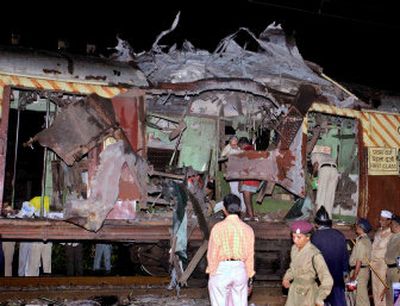
One by one down the railway line, the bombs went off, ripping apart the trains, tearing through flesh and paralyzing what is arguably India’s most vibrant city.
The eight blasts struck during Bombay’s busy evening rush hour Tuesday, killing 190 people and wounding hundreds in a well-coordinated terror attack on the heart of a city that embodies India’s global ambitions.
Suspicion quickly fell on Kashmiri militants who have repeatedly carried out nearly simultaneous explosions in attacks on Indian cities, including bombings last year at three markets in New Delhi.
Pakistan, India’s rival over the disputed territory of Kashmir, quickly condemned Tuesday’s bombings. Even so, India alleges that Pakistan supports the Muslim militants, and analysts said a Kashmiri link to the blasts could slow – or perhaps even derail – a peace process that has gained momentum between the nuclear rivals over the past several years.
Indian Prime Minister Manmohan Singh said “terrorists” were behind the attacks, which he called “shocking and cowardly attempts to spread a feeling of fear and terror among our citizens.”
Security was tightened in cities around the world from New Delhi to New York after the eight blasts aboard seven trains. The bombings appeared timed to inflict maximum carnage in this bustling Arabian Sea port of 16 million, more than 6 million of whom ride the crowded rail network daily.
The Press Trust of India news agency said early today that police had increased the toll to 190 killed and 625 injured. In the hours immediately after the attacks, officials put the toll at 147 dead and 439 injured.
Emergency crews struggled to treat survivors and recover the dead in the wreckage during monsoon downpours, and the effort stretched into the night. Survivors clutched bandages to their heads and faces, and some frantically tried to use their cell phones. Luggage and debris were spattered with blood.
The mobile phone network collapsed, adding to the sense of panic across the city. With train services down until midnight, thousands of people were stranded.
There was no immediate indication if suicide bombers were involved. Police inspector Ramesh Sawant said most of the victims suffered head and chest injuries, leading authorities to believe the bombs were placed in overhead luggage racks.
The Press Trust of India, citing railway officials, said all the blasts hit first-class cars – a sign the assailants were targeting the professional class in a city that has come to embody India’s 21st century ambitions.
Bombay, also known as Mumbai, is the center of India’s booming financial industry and the home of Bollywood, a city that presents itself to the world as a cosmopolitan metropolis where bankers dine with movie stars and fashion models party until dawn.
While that image captures one side of life in the city, Bombay is also crowded and largely poor. And across the city, the prosperous and downtrodden worked together to aid survivors.
As police and rescue services struggled to reach the blast scenes through Bombay’s jammed, chaotic everyday traffic, bystanders pulled the wounded from the debris, offering them water and bundling them into every available vehicle.