
White House trims deficit estimate

WASHINGTON – The Bush administration on Tuesday lowered its estimate of this year’s federal budget deficit by 30 percent, to $296 billion – a figure that prompted the White House to claim vindication for its tax cuts, and Democrats to issue new denunciations of the nation’s fiscal problems.
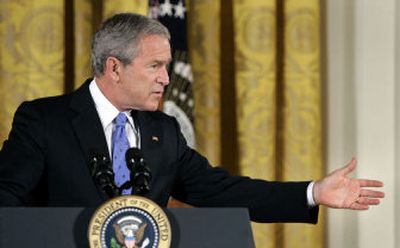
In its midyear report on the budget, the administration projected that tax revenue will increase 11 percent in the fiscal year that ends Sept. 30. That is “much better than we had projected, and it’s helping us cut the budget deficit,” President Bush said in a White House ceremony to release the report, which is usually a low-key midsummer event. “Tax relief is working. The economy’s growing. Revenues are up. The deficit is down.”
The president and his top aides tempered their enthusiasm by acknowledging that over the next several decades, the deficit outlook will drastically worsen as the nation bears the retirement and health-care costs of the baby-boom generation.
Bush hinted that he is planning to tackle the long-term costs of Social Security, Medicare and Medicaid before the end of his second term. “It’s so much easier to shove these problems down the road,” he said. “We need to fix this for younger generations of Americans to come.”
But his overall message was to claim credit, which so far has eluded him, for the strength of the economy and the resulting near-term improvement in the budget. Recalling a promise he made 2 1/2 years ago to cut the deficit in half by the end of his presidency from the $521 billion that the administration projected for 2004, he said, “We’re now a full year ahead of schedule.” (The deficit for 2004 turned out to be lower than the projection – $412.7 billion, still an all-time high in nominal terms.)
Bush noted that the projected $296 billion deficit would be about 2.3 percent of the gross domestic product, and he likened it to a mortgage that could be easily borne by a homeowner with a rising income. “When the economy expands, our nation’s income goes up and the burden of the deficit shrinks,” he said.
Democrats and other critics said the president had no right to brag about a deficit that remains so large in the fifth year of an economic expansion. They pointed out that the deficit this year will be the fourth-largest ever, and that Bush inherited a surplus when he took office in 2001.
“Only Washington Republicans would think a $300 billion deficit is good news,” Senate Minority Leader Harry Reid, D-Nev., said in a written statement.
Maya MacGuineas, president of the Committee for a Responsible Federal Budget, a bipartisan group, said the new figures are “nothing to break open the champagne over.”
“We have experienced a neck-wrenching swing from large surpluses to large deficits since the start of the decade,” MacGuineas said.
Democrats also disputed Republican claims that the sharp increase in tax receipts over the past couple of years shows that tax cuts are working. Although they conceded that revenue has soared in 2005 and 2006 with the hefty boost in corporate profits and incomes of Americans at the top tax brackets, they noted that after adjusting for inflation and growth in population, tax revenue hasn’t grown overall during Bush’s presidency.
“In 2000, we had just over $2 trillion of revenue,” Sen. Kent Conrad, D-N.D., said at a news conference. “Then we had the big tax cuts in 2001. Revenue went down the next year. Revenue went down again the next year. We had more tax cuts in 2003. … Only in 2006 are we getting, in real terms, back to the revenue we had in 2000.”