
Low river draws mixed watercraft
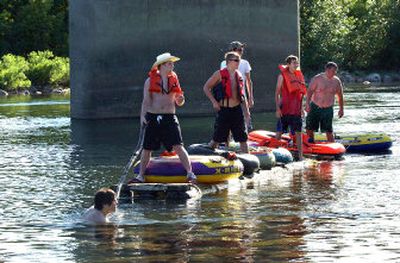
As temperatures rise and water levels wane, the craft navigating the Spokane River become more eclectic.
“The best part about this is seeing people on pool toys and stuff,” Blake Albretsen said just before launching a group of rafts at the Barker put-in.
On the popular stretch between Barker and Sullivan roads, he said, he’s seen people on, among other things, inflatable alligators and floating chaise lounges.
In recent weeks, the waters where seasoned kayakers and canoeists ply their white-water skill in the spring are now shared by al manner of casual floaters.
That’s fine, officials say. But even though the river may not be as deep or as swift in many places, police are still enforcing county life jacket laws as vigorously as ever.
“We’re getting better compliance, but we’re still not there,” said Deputy Tom Walker, who leads Spokane County’s marine patrol.
County ordinance stipulates that anyone boating or floating on moving water must wear a securely fastened life jacket.
Walker has handed out as many as 48 tickets in one day in years past, he said, but only five people have been cited so far this year.
Rescue crews have retrieved several bodies from the river already this summer, and Walker stresses common sense when it comes to safety on the river.
“If you don’t know how to read the river, you can get yourself in trouble,” he said.
Boaters who plan to go through rapids are encouraged to take a swift-water training course and learn basic rescuing techniques.
Even in calmer water, it’s important to be wary of hypothermia, to stay away from snags and to go with someone familiar with the stretch of river about to be floated, Walker said.
He advises against running the river in any type of boat when the river is flowing at 30,000 cubic feet per second. Below 2,500 cubic feet per second, like the river is now, is generally when it’s safe to break out the inner tube, he said.
On shore, school resource officers and police on bicycles have recently been keeping an eye out for suspicious activity at parking lots during their regular patrols on the Centennial Trail.
More than 100 crimes have been reported along the trail so far this year – about the same number reported in the previous two years, said Sgt. Dave Reagan of the Sheriff’s Office. Just more than 90 of those were car break-ins or thefts.
“You can be in and out of a car in 30 seconds with a rock,” he said.
The rise in identity theft could be behind the increase in break-ins, Reagan said. Items such as checks, identification and credit cards left in vehicles at trailheads can make an easy target, and police are asking people to keep valuables out of sight or locked in the trunk.
Most of the thefts occur when vehicles are unattended. Reagan said the trail itself remains “a safe place to play and exercise.”