
Homeless artist leaves his mark

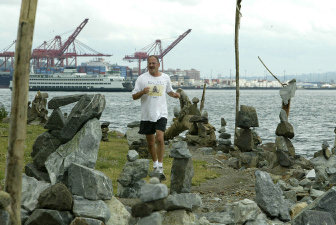
SEATTLE – A homeless man’s wood and stone sculptures along the Elliott Bay waterfront are drawing attention, even as a multimillion-dollar sculpture park is being built nearby.
The short, muscular artist with clear blue eyes and thick, wiry red hair prefers to remain a mystery, giving only the nickname “Stacker” and his age, 40. He politely declines to give his real name, saying he wants to keep his personal story to himself.
Stacker did say he’s been on the road since he was 13 and he works as a day laborer when he needs money.
“Sometimes I paint houses,” he said. “Sometimes I dig ditches, and sometimes I’m a roofer. I’m art all the time.”
Hundreds of his formations are at Myrtle Edwards Park on the waterfront; he uses the materials he finds there.
He starts by stacking rocks, a common practice used to mark trails in Japan, best known in Seattle by the late George Tsutakawa’s tribute to it, which he carved in wood and called obos.
Unlike Tsutakawa’s, Stacker’s sculptures are rougher, with a delicate balance between heavy and light materials.
It’s a mystery even to him how the jagged rocks stand on boulders in such precarious positions.
“I’m going to tell you like it is. I don’t know,” he told the Seattle Post-Intelligencer.
Stacker said he arrived in Seattle about five weeks ago and made his way to the waterfront, where he began his rock and wood piles a few feet from the Seattle Art Museum’s $85 million Olympic Sculpture Park, currently under construction.
“Lots of pennies over there,” he said. “No pennies here.”
Stacker believes his original slate was wiped clean by park workers clearing the way for crowds expected for Fourth of July fireworks.
That only inspired him to redouble his efforts.
“When I make art, I go for the zone. I can feel it when I’m there, like a surfer on a wave,” he says.
Some rocks he piles into short pillars along the shoreline. Others he turns into circles in the grass, a few with a faint indentation that might be a heart.
He knows his waterfront sculptures won’t last more than a season, and he’ll move on.
“When they’re gone, they’ll still be beautiful,” he said.