
World Wild Web
Across the country, from classrooms to living rooms, people have been revving up their computers to see the next generation of peregrine falcons hatch, grow and fledge on a ledge of a Harrisburg, Pa., office building.
The drama unfolds via cameras perched nearby, feeding photos and video to the Internet. Focused so close you can see the birds breathing, the cameras provide an instant fix for wildlife voyeurs.
By all accounts, their appetites — the watchers’, that is — are voracious. And wildlife cams are proliferating.
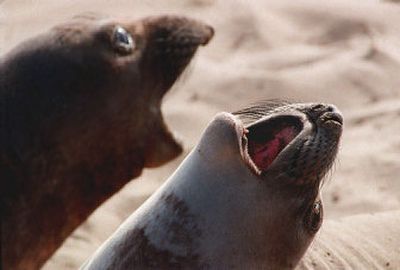
You can click on to a beachful of elephant seals off the California coast who look cool, even if they’re only sunbathing.
You can set your screen to the panda cam at the National Zoo, where nine-month-old Tai Shan might be munching bamboo.
A Web celeb since his debut as a newborn last July, garnering 18 million hits in nine months, the panda gets fan mail from folks around the world, including U.S. soldiers in Iraq.
EarthCam, a Hackensack, N.J., company that sells equipment and tracks cams, lists 225 in its “animals and pets” category, from penguins and sharks to ants, koalas and polar bears.
A click of a mouse will bring up herons in Washington, elephants in Africa, or fish swimming the Schuylkill’s Fairmount fish ladder in Philadelphia.
Nest-box cams are big because cameras can get close and zoom in on babies.
More than 15,000 bats have returned to the cam-rigged attic of a 19th-century church in a state park near Altoona, Wash.
The cams show “how small the world can be,” said John Gibbons of the National Zoo, which has 18 Web cams, including ones for naked mole-rats, Amazon fish, and an octopus.
Credit technology. Long-distance streaming video has been around since the moon walk in 1969. But now the equipment is cheaper, and more reliable.
In a way, no paparazzo ever had it easier. Unlike human starlets that flit to snazzy nightclubs, wildlife species can be conveniently predictable.
Each spring, half a million sandhill cranes stop at Nebraska’s Platte River Valley, where National Geographic cameras await.
Every August, the start of the dry season at a Botswana reserve, the local wildlife can be counted on to visit a particular watering hole. Nearby, a ranger in a blind adjusts the aim of more National Geographic cameras, often answering viewers’ questions in real time.
For better or worse, zoo animals are the most predictable; they have no choice.
Interest has been overwhelming.
Blackwater’s cams get 2,000 to 3,000 hits a day, although one surge of interest brought its telephone line to its knees. It was replaced with one “the size the Pentagon uses,” said volunteer Tom Hook.
Amazed cam operators joke that people must have a lot of free time. Beyond that, they can’t figure out why people are so interested, other than that they really love wildlife.
Some places — a falcon ledge, for instance — are inaccessible. “You get a glimpse into something that people would never ordinarily be able to see,” said Bill Heinrich, of the nonprofit Peregrine Fund, which works to conserve birds of prey.
Other places — like the Race Rocks islands in British Columbia — are too environmentally sensitive for hordes of humans, trampling the flora and scaring the fauna. Its cameras provide minimal-impact tourism.
Most cam sites foster conservation and include a strong educational component, with screens full of information and special Web events for schools.
Zatz thinks a lot of people have “skewed” ideas of nature, partly because of edited footage on TV. “Watching nature unfold at its own pace,” he said, “is very, very valuable,” because it’s closer to reality.
Many cams double as research tools.
Cams even reap funds for wildlife. Washington Department of Fish and Wildlife, which has eight cams and more in the works, gets a steady trickle of money from a click-on icon.
When one of the New Jersey falcon cameras crashed last year — it was a dramatic season; the male lost a wing — Linn Pierson pleaded for funds in her “Nestbox News” column on the cam site.
Within a week, they had enough to buy two.