
Resources at your fingertips
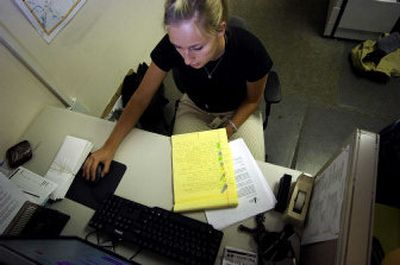

A lone data clerk is slowly entering hundreds of records into Spokane’s 211 database, the telephone referral service that proponents hope will become as useful – and familiar – as 911.
With every click of Michelle Morris’ keyboard, the region moves a little closer to implementing the health and social service resource that will offer information about needs from child care and churches to gas vouchers and free food.
“I’m actually staring at an Excel spreadsheet of 500 agencies that I’ve put together,” said Morris, 22, the first staff member hired for the regional project expected to go live in September.
“The way that I describe it to people is it’s the 411 for social services, but free.”
Spokane will be among the last of eight regions statewide to implement the three-digit information line. In February, the free, confidential service began in a dozen counties in four regions, mostly on the West Side.
In those areas, callers to 211 have been able to link to what organizers envision will one day be a statewide system that’s both fully integrated and intimately local.
The effort is the culmination of nearly six years of steady work by the Washington Information Network 211, whose goal is to create a system able to provide assistance every day – and during emergencies.
“I think that it’s going to be able to disperse the resources more evenly,” said Morris. “A lot of people just go to the Salvation Army or to the Red Cross because they don’t know where else to go.”
As she adds information to the local database, Morris said she’s been amazed at the range of services available.
“There are places that give out gas vouchers and food vouchers,” she said. “If you’re really in need, there are places you can go in Spokane.”
By the end of this year or early next year, the state’s eight call centers are expected to share a database and a communication system, but they’ll still be staffed by people in the local communities, said Susan Gemmel, director of 211 King County, which is run by the Crisis Clinic of Seattle.
“Part of the feeling was it would be better if you could have somebody locally who knows the area and has the local connection,” Gemmel said.
In Seattle, early projections estimated calls would jump from about 78,000 calls a year to 140,000 as users became familiar with the scope of the new service. That amounts to between 400 and 500 calls on a typical Monday, the busiest day of the week, Gemmel said.
The Washington Legislature approved $2.5 million for the project during this past session, noted David Panken, chief executive officer of Spokane Mental Health, the agency coordinating the local 211 push. That was combined with about $1 million in state capital funds and another $1 million from the Bill and Melinda Gates Foundation. Nationwide, the project also has been supported by United Way agencies.
Locally, organizers expect to need about $340,000 a year to operate the program, Panken noted.
“We’re looking for long-term sustainability here,” he said. “We’re going to need ongoing support from state and federal sources.”
Across the state, 211 agencies have been frugal with their resources, slowly adding staff only as needed. In Spokane, Morris’ $11-an-hour job was the first position filled.
“Eventually, it’s not just going to be me,” said Morris, a recent Washington State University graduate who believes her new job puts her psychology degree to good use.
Proponents note that 211 systems have handled hundreds of thousands of calls during hurricanes, fires and other natural disasters. One of the benefits, noted Panken, is that the system relieves pressure on the 911 system, allowing staff to focus on life-threatening emergencies.
“Part of the goal is making sure that 911 and 211 is clearly understood,” he said.
Before Spokane’s system goes live, local organizers plan a public education campaign. Those who’ve already done it said it takes time for the new system to sink into public consciousness.
“There are even a lot of people here who’ve just never heard of it,” said Gemmel. “As time goes on, it’ll become more and more familiar to the community. Most of us think 911 was always there, but it wasn’t.”