
Open for business
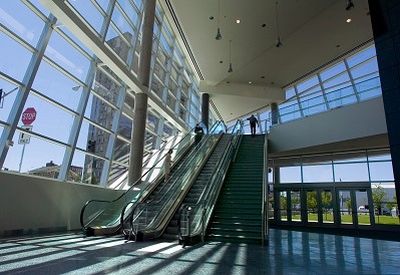
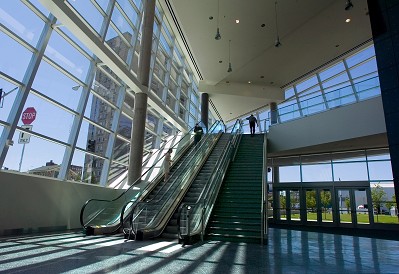
Spokane’s stature within the convention industry rises dramatically today as the city celebrates the grand opening of its $75 million Group Health Exhibit Hall. The near-tripling in convention center space will catapult Spokane into the challenging, but promising, world of competition for more national business.
Prior to the new exhibit hall, Spokane had 57,000 square feet of exhibit space, placing it 269th in a national ranking of 313 venues. With the opening of the 100,000-square-foot hall, Spokane moves up 100 places to 169, according to the Spokane Regional Convention and Visitors Bureau. Chicago is No. 1, with 2.2 million square feet, followed by Orlando, Fla., and Las Vegas.
“We’re in a whole new dating pool, because we’re courting people we could never really talk to before,” said CVB President Harry Sladich. “We could never have called them up and asked them out.”
That new pool could reshape the convention industry in Spokane, with hoteliers adding space and renovating, more sales people selling exhibit space, and the tourism industry getting used to a new way of doing business.
The CVB sales staff has identified 120 organizations whose space needs Spokane can now accommodate and is in negotiations with 36 of them. Because of the accelerated activity, the CVB has added two sales positions and is planning a third – to keep track of hotel bookings – soon. The Spokane Public Facilities District also added a sales position in anticipation of the extra space, said Johnna Boxley, the Convention Center’s general manager.
Before the expansion, the city primarily pursued state and regional convention business. National business represented only 15 percent to 18 percent of the total. National business now represents 37 percent of the total, CVB officials said.
However, competition also has grown because of a national convention center-building spree. In Washington state alone, about a dozen cities are building or expanding space. In larger cities nationally, some hotels have more exhibit hall space than Spokane has in its flashy new ship-shaped hall. And those larger hotels can house all the delegates in one place.
And despite making gains – whether through the U.S. Figure Skating Championships or Gonzaga University basketball – Spokane is still relatively unknown on the national scene.
“We’ve just had to work harder,” Sladich said. “If I’m San Diego, the phone is just ringing. But in Spokane, the phone ain’t ringing. We’re dialing.”
But the extra challenge breeds creativity, tourism officials said. And so far, it appears to be paying off. Though convention business dropped 20 percent to 25 percent during construction, Boxley said, bookings look promising going forward from 2008, the first full year of business following construction. To date, 88 events have been booked into the new exhibit hall through 2012. Those events represent 108,000 hotel room nights and an infusion of visitor dollars totaling $78 million. Some 16 of the events, representing a $60 million economic impact, would not have been able to squeeze into Spokane’s prior convention space.
By far the biggest of those is the State Farm U.S. Figure Skating Championships, which alone represents a $25.4 million infusion of visitor dollars.
“For us, the bottom line was – without the new Convention Center, we would not even have been considered,” said Spokane skate promoter Barb Beddor, of Star USA. The skating event required two 200-foot-long sheets of ice. One will be in the Spokane Veterans Memorial Arena, the other in the new exhibit hall. “For eight days, there are people on the ice at both of those venues, either in practice or in competition, from 6 a.m. to 11 o’clock at night. That’s the importance of that secondary venue,” she said.
Bookings for 2008 at the Spokane Convention Center currently are running about 36 percent, Boxley said. However, that only includes conventions, not the smaller shows – such as consumer shows, meetings and community events – that fill the remaining space. That space is still being sold with a goal of around 60 percent annual occupancy, she said.
Spokane’s grand hotel, The Davenport, is betting on that business. Construction of an addition, called the Davenport Tower, is under way, with completion forecast for January. When it’s finished, the combined Davenport will be the city’s largest hotel, with 602 rooms. Frequently, that will enable the hotel to host all, or most, of a convention’s delegates in one place, rather than spreading them out among several sites.
“If the Convention Center hadn’t expanded, we wouldn’t be expanding,” said Lynnelle Caudill, the Davenport’s general manager. “That’s a big part of it. It definitely has given us the confidence.”
Historically, about 57 percent of the business in the Convention Center has been actual conventions, Boxley said. The remaining 43 percent has been smaller events. As a result of the additional space, several long-standing consumer shows have made plans to expand their events, and Spokane is fielding calls from shows in other states, she said.
“It’s nice to be able to tell them we have a 100,000-square-foot exhibit hall, because now they’ll at least start the conversation with us,” Boxley said.
That conversation inevitably includes rental rates, which range from 7 cents a square foot to rent exhibit hall space to 30 cents a square foot for meeting rooms. A convention that booked the entire 100,000-square-foot exhibit hall would pay about $7,000 a day. With many national venues offering free or vastly reduced rent, competing has “become a nightmare in the convention industry,” Boxley said.
However, tourism officials have come up with ways to compete, such as raising hotel rates slightly to cover the cost of renting the exhibit hall, then having hotels “rebate” that money to the PFD for rent. Spokane’s more affordable hotel rates provide wiggle room in negotiations, said Sladich, a former hotelier.
CVB officials also stress the importance of the Tourism Promotion Area funds they receive to help attract events to Spokane. The CVB’s share of the fee tacked onto hotel rooms is about $1.2 million annually, or half the budget. The money has paid for additional staff and attendance at three times more trade shows.
At the Religious Conference Management Association meeting, the CVB landed the 2008 American Baptist Association’s annual convention, representing $1.3 million in visitor dollars and drawing at least 1,500 people. The association’s director of meeting arrangements, Edgar Sutton, said the Spokane team’s presentation put the city above Albuquerque, N.M., and Fresno and Ontario, Calif.
“They really came with the idea of getting the meeting,” Sutton said. “They really sold us on their city.”