
Lewis and Clark events a historic flop
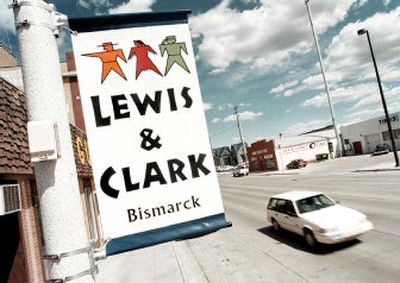
Paging Sacagawea: Lewis and Clark have lost their way again.
When President Bush issued a proclamation in 2002 creating a Lewis and Clark Bicentennial celebration, tourism officials from Virginia to Oregon pounced on it as a potential blockbuster. But as the three-year celebration enters its homestretch, participating communities are still waiting for the Lewis and Clark gravy train to leave the station.
“It’s the great Lewis and Clark letdown,” says Dave Hunt, a Lewiston-based wholesaler of bicentennial knickknacks, including commemorative spoons and refrigerator magnets. In June, the town held a festival to mark the time in 1806 when the pair dropped in on a local Nez Perce Indian tribe. But the festivities – a quilt and animal hides show, a craft fair and a reenactment – drew only a trickle of visitors.
Washington state expected as many as 10 million people to attend a number of events, including boat tours of the expeditionary group’s route along the Columbia River. Fewer than a million showed up.
St. Charles, Mo., where the explorers began their epic journey, was similarly disappointed. The town anticipated as many as 500,000 visitors for its 10-day festival but ended up with about one-tenth that number.
And Great Falls, Mont., learned the hard way how many people were interested in its claim to Lewis and Clark fame. So few people turned out last summer to commemorate the pair’s portage around the falls of the Missouri River that the city ended up $535,000 in debt. Ticket sales failed to cover the $1.6 million cost of staging events including river tours and a powwow. Says organizer George Horse Capture: “People acted like they would rather stay home and mow the lawn.”
The explorers traveled more than 8,000 miles by land and river from Missouri to Oregon between 1804 and 1806, opening the Louisiana Purchase to Army exploration and settlement. An estimated $70 million to $100 million of city, state, federal, private and corporate money has been spent building infrastructure and staging events to honor that achievement. But tourism experts say the project was doomed from the start. Interest in the pioneer West has waned in the broader culture, they note, and Lewis and Clark aren’t a big draw east of the Mississippi. Most important, they say, events such as craft fairs and historical reenactments don’t make most vacationers hop a plane.
The bicentennial also suffers from a subtle but critical problem, says Stephen Dow Beckham, a professor at Lewis & Clark College in Portland and an expert on the expedition: America’s view of what makes a hero has changed and, to many, Lewis and Clark no longer make the cut.
Indeed, in a culture that takes a more nuanced view of history, the explorers now come with a lot of political baggage that makes them a hard sell to tourists. People remember Meriwether Lewis and William Clark as expert adventurers. In reality, says Beckham, they were smart but flawed guys who could have gotten lost on the way to the outhouse, never mind the rugged wilderness.
“Lewis had a drinking problem and ultimately committed suicide, while Clark worked to confine Indians to reservations,” Beckham says. “These men helped make America a continental nation, but the commemoration is noting – rightly – the harm they did to Indian nations in the process.”
Native American groups have protested the bicentennial. Many participating tribes are taking part only bitterly, staging lectures and screening films that conflict with the tales of undaunted courage many tourists want to hear.
The president of the nonprofit National Council of the Lewis & Clark Bicentennial, Robert Archibald, defends the whistle-stop extravaganza. “I’m very pleased and very proud of the way it has worked out,” he says. Archibald concedes, however, that some communities expected more of an economic boost than they have gotten from the bicentennial. “When you set these overly optimistic targets and then fall short, it is suddenly a big failure,” he says. “I think everybody should be happy with the turnout.”