
Bike riders eye skate park
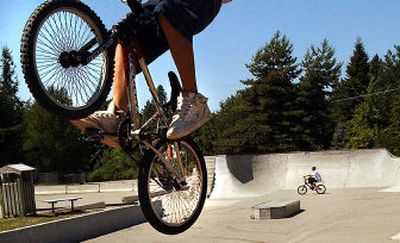
Gerald Dale just wants a place where he and others who share his passion can have fun and let loose without being cited by the police and forced to leave.
But the writing on the wall – on a sign, actually – doesn’t accommodate the sport Dale has been involved with for more than a decade. Instead, it tells him and fellow freestyle bicyclists they aren’t allowed to ride on a giant slab of asphalt adjacent to the skate park near Coeur d’Alene’s City Park.
The city ordinance behind the sign has been in effect for several years now, prompted by an incident in which a biker ran into a young skateboarder. It usually keeps the freestyle cyclists at bay, but not always.
“All we’re trying to do is have fun and ride,” said Dale, 22, a Coeur d’Alene resident and president of the recently formed Northwest Freestyle BMX Association. “We have no place to do what we want to do.”
Members of the group plan to present their case to the Coeur d’Alene City Council in September. As a first step, the freestyle riders met earlier this week with city recreation officials, who appear to support finding a place where Dale and other riders would be welcome, said Woody McEvers, a Coeur d’Alene City Council member and the freestyle BMX association’s guiding force behind the drive.
“I think they understand there is a need for it,” McEvers said.
In other parts of the region, BMX bikers are welcome to share skateboard parks.
BMX bikes are allowed in the Hillyard skate park and at the skate parks below Interstate 90 on East Fourth Avenue and South McClellan Street and in Sky Prairie Park, said Tony Madunich, manager for the park operations division at the Spokane parks department.
Riders must wear helmets, as required by city ordinance, and the axle picks must be skate park approved, meaning they will generally do less damage to concrete when riders crash.
“It was kind of a conscious decision that we would not exclude any group from using it,” Madunich said. “Ideally, at some point in the future, we’d like to build a BMX track and course.”
In downtown Coeur d’Alene, the 90-foot-by-50-foot, concrete-barricaded rink near the park was built for inline skating and hockey. It doesn’t get much use now. If bike riders do venture over to it for some flatland stunts, they can be ticketed for misdemeanor trespass. And that does happen, Dale said.
The only other places he and the other freestyle cyclists say they can ride are on city streets or at freestyle parks in Spokane and the Tri-Cities area. The Coeur d’Alene-area freestyle riders will ask the City Council to approve a trial period during which they could re-enter the park.
“It would be awesome if we could take it over and maintain it,” Dale said.
But city officials have been skeptical. They tried it before but saw little success, Councilwoman Dixie Reid said.
“Those kids were fighting and beating the tar out of each other,” Reid said at a recent council meeting. “I’m not sure what will change now.”
But McEvers believes things are different now. “The problem is one or two bad apples break something or get into trouble and they all get blamed for it,” he said.
McEvers spent a day at the skateboard park several weeks ago to help rebuild a battered deck on a concrete ramp. Several volunteers, including the founders of the Northwest Freestyle BMX Association, approached the city councilman. They wondered what it would take to change the law banning bicycles from the rink.
The biggest problem, he said, was getting an organized group of cyclists to approach the city. But the riders formed the group and are putting together a packet of information that covers liability, costs and maintenance. The liability becomes an issue if ramps or other structures are built on the site and require maintenance.
“That is an issue we are going to have to look at,” City Attorney Mike Gridley said. If the city did provide ramps, it would have an obligation to keep them in a safe condition, Gridley said.
That’s not the question at hand, McEvers said.
“Right now the whole issue is, ‘Can they use that space?’ ” he said.
Others have asked if the city needs another BMX park. Last August, a public BMX racetrack was completed at Cherry Hill. There, BMX riders of all levels race competitively on the American Bicycle Association-certified track, or just for the fun of it, for free.
BMX racing, however, is just one distinctive part of the overall world of bicycling, said Terrence Northington, vice president of North Idaho BMX.
“For the most part it’s two different crowds,” Northington said.
The freestyle BMX riders are more akin to the rail-grinding skateboard tricksters next to the asphalt rink than the flat-out bike racers found at Cherry Hill. Ramps, rails and flat ground are the preferred environments of freestyle riders, in contrast to the dirt-covered courses of BMX racers.
“Freestyle and BMX racing are two different aspects of the sport,” Dale said.
And with their desire to find a place of their own to play, the freestyle cyclists are hoping to be able to call the rink their home by next spring.
“I have a lot of regard for them. They are really stepping up,” McEvers said.
“I can give them support and direction, but I’m only one vote.”
For Dale, the rink and legal right to ride there are the means to a freestyle-riding end, and it’s all worth the effort.
“It keeps me out of trouble,” he said.