
Bush sending more troops to Baghdad
WASHINGTON – President Bush said Tuesday that he is sending more U.S. forces and equipment to Baghdad as part of a fresh strategy to put down rising sectarian violence, abandoning a six-week-old operation that failed to pacify the strife-torn Iraqi capital and opening what aides called an unexpected new phase of the war.
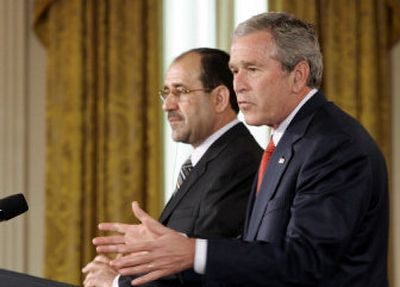
Hosting Iraqi Prime Minister Nouri al-Maliki at the White House for the first time, Bush sounded unusually dour and acknowledged that the situation in Iraq in many ways has worsened lately. But he vowed to adjust tactics to deal with evolving threats and to keep U.S. forces in Iraq as long as necessary to fortify al-Maliki’s government until it can defend itself.
The additional U.S. forces for Baghdad, which could total in the thousands, would come from elsewhere in Iraq, but the deteriorating security situation seemed to all but doom the prospect for significant troop withdrawals before the November congressional elections. The Pentagon had drawn up scenarios that envisioned pulling out as many as 30,000 troops this year, but military officials said Tuesday those now appear implausible and U.S. forces probably will remain at the current level of 127,000 for several months at least.
“Obviously the violence in Baghdad is still terrible and therefore there needs to be more troops,” Bush said during a news conference with al-Maliki. “Conditions change inside a country,” he added. “And the question is: Are we going to be facile enough to change with (them)? Will we be nimble enough? Will we be able to deal with the circumstances on the ground? And the answer is, yes, we will.”
Al-Maliki, who took office two months ago, likewise expressed resolve in the face of bombings and death squads that have inflicted increasing casualties on civilians. But he ended the news conference with a foreboding comment suggesting how close to the edge he considers his country. “God willing,” he said, “there will be no civil war in Iraq.”
The two leaders tried to present a united front and made no public mention of disagreements about amnesty for Iraqi insurgents or immunity for U.S. troops. They did have what the president called “a frank exchange” over the conflict in Lebanon, with al-Maliki calling for “an immediate cease-fire” and Bush supporting only “a sustainable cease-fire” that addresses the region’s broader issues first.
Al-Maliki did not directly repeat his recent criticism of Israel’s military operation, nor did he respond to a question about his position on Hezbollah. His previous statements condemning Israel for the conflict have stoked anger on Capitol Hill, where House and Senate Democrats called on him to clarify his stance before being allowed to address a joint session of Congress today.
For that and other reasons, al-Maliki’s inaugural visit to the White House had none of the triumphal mood of Bush’s surprise trip to Baghdad to meet the new prime minister June 13. The heady spirit of that day, coming just after the killing of al-Qaida’s leader in Iraq, Abu Musab al-Zarqawi, and coinciding with a new Baghdad security plan called Operation Forward Together, seemed a distant memory as Bush and al-Maliki stood in the East Room Tuesday with grim expressions and somber tones in their voices.
“No question, it’s tough in Baghdad,” Bush said, “and no question, it’s tough in other parts of Iraq. But there are also places where progress is being made.”
The Bush administration is trying to respond to the shifting nature of the war. Where once U.S. forces were focused primarily on anti-U.S. foreign fighters and Sunni insurgents, today they confront a more complicated situation in which de facto militias are targeting Iraqis, in some cases aided by Iraqi police forces commanded by the Shiite-led Interior Ministry.
“It’s a new challenge,” national security adviser Stephen Hadley said after Tuesday’s Bush-Maliki meetings. “This isn’t about insurgency. This isn’t about terror. This is about sectarian violence.”
Security analysts said that the administration has not yet figured out a way to deal with the militias and will not get anywhere until it does. “It’s clear the Interior Ministry is out of control,” said Michael Rubin, a resident scholar at the American Enterprise Institute and former adviser to the U.S. occupation authority in Iraq. “Death squads are never acceptable.”
Bush and his aides were vague about the new Baghdad security strategy, but he said it would involve embedding more U.S. military police with Iraqi police units. The combined forces, he said, would secure individual neighborhoods “and gradually expand the security presence as Iraqi citizens help them root out those who instigate violence.”
Military officials said the U.S. contingent brought into Baghdad could be as large as a brigade, which would mean thousands more troops joining the 30,000 now deployed in the capital area. A reserve force held in Kuwait has already moved largely into Iraq, so officials said additional U.S. forces for Baghdad could come from areas recently passed to Iraqi control, such as Muthanna province in the south or Mosul in the north.