
Iraqi leader asks U.S. for more funding

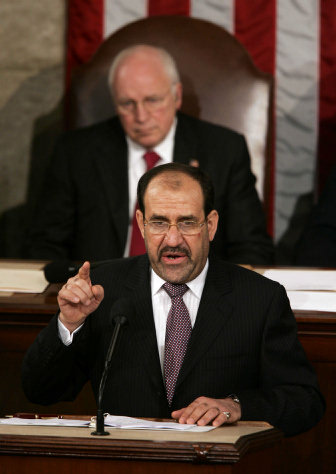
WASHINGTON – A day after securing a pledge from President Bush to bolster U.S. troop presence in Baghdad, Iraqi Prime Minister Nouri al-Maliki asked Congress on Wednesday for more reconstruction aid, acknowledging that most of the billions already allocated were swallowed by security costs.
And he warned the United States not to abandon Iraq, as it did after the Persian Gulf War when the United States stood aside as a Shiite rebellion was crushed by Saddam Hussein.
“Let 1991 never be repeated, for history will be most unforgiving,” al-Maliki said during a speech to a joint session of Congress.
He used the speech to reaffirm his new government’s commitment to the war on terrorism, pledging that “Iraq will be the graveyard of terrorism and terrorists for the good of all humanity.”
Republicans had hoped to use al-Maliki’s visit to showcase progress toward democracy in Iraq, but the prime minister’s two-day stay in Washington proved to be politically problematic. Bush’s promise to fortify troop presence in Baghdad virtually foreclosed major troop withdrawals before November’s midterm election. And al-Maliki declined to disavow his critical comments on Israel’s incursion into Lebanon or denounce Hezbollah’s killing and kidnapping of Israeli troops that precipitated the fighting.
At a breakfast meeting Wednesday with congressional leaders, Democrats repeatedly pressed al-Maliki to declare Hezbollah a terrorist organization, but al-Maliki would not reply beyond broad denunciations of terrorism, according to several participants.
Democrats such as Sen. Charles Schumer of New York protested the prime minister’s oblique stand on Hezbollah and his denunciation of Israeli “aggression” by refusing to attend al-Maliki’s address, forcing congressional leaders to fill empty seats in the House chamber with youthful aides.
Other Democrats, such as Rep. Debbie Wasserman Schultz of Florida, sat in stone-faced silence, then decried the speech for its failure to recognize Middle East terrorism beyond Iraq’s borders or to be frank about sectarian strife that is killing an estimated 100 Iraqis a day.
“He essentially ignored the fact that he is the president of a war zone,” Wasserman Schultz said.
Amid such discord, al-Maliki struck lofty tones as he thanked the United States for standing by Iraq.
“Many around the world underestimated the resolve of Iraq’s people and were sure that we would never reach this stage,” he said. “Few believed in us. But you, the American people, did, and we are grateful for this.”
But he also inserted himself into the election-year controversy over the war, acknowledging, “I know that some of you here question whether Iraq is part of the war on terror.
“The fate of our country and yours is tied,” he continued. “Should democracy be allowed to fail in Iraq and terror permitted to triumph, then the war on terror will never be won elsewhere.”
Al-Maliki also appealed to Congress for more reconstruction aid, which the Bush administration has been reluctant to request after much of the $18 billion in development assistance was consumed by security costs, corruption and inefficiency.
“Much of the budget you had allocated for Iraq’s reconstruction ended up paying for security firms and foreign companies, whose operating costs were vast,” al-Maliki told Congress. “Instead, there needs to be a greater reliance on Iraqis and Iraqi companies, with foreign aid and assistance to help us rebuild Iraq.”