
Thinner Saddam remains defiant as defense wraps up
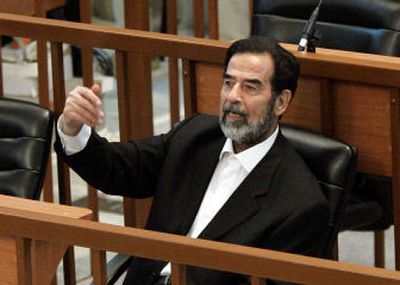
BAGHDAD, Iraq – Gaunt and pale, but distinctively impertinent, Saddam Hussein emerged from a hunger strike for closing defense arguments Wednesday in the trial examining alleged crimes against the Shiite population during his regime.
The former Iraqi president, who had been fed through a tube while hospitalized for the past three days, lashed out at Judge Raouf Rasheed Abdel Rahman, at his own court-appointed lawyers and at the U.S. troops who toppled his dictatorship.
“You are my enemy,” said Saddam, jabbing his finger at the court-appointed lawyer assigned to present his defense after his own attorneys boycotted the trial. “Why do you impose yourself as an enemy of the Iraqi people?”
The attorney continued reading from a final defense statement that stretched 75 pages.
“I don’t want my history to be stained by this,” Saddam interrupted.
“You don’t write the history,” the judge retorted. “The people write it.”
“Yes, the people and the people’s heroes,” said Saddam, who claimed he was forced to attend Wednesday’s session and repeatedly asked to leave.
The hunger strike did not diminish Saddam’s determination to turn the trial into a theatrical commentary on Iraq’s current affairs. Saddam and seven former regime officials face a potential death penalty if convicted of a massacre of 148 villagers in the northern village of Dujail after a 1982 assassination attempt against him.
Saddam’s court-appointed lawyer, reading in a dull monotone, raised dozens of points, questioning the hearsay nature of the evidence presented against Saddam.
He argued that charges of mass murder against Saddam were unwarranted, drawing on precedents set in examining the crimes against humanity in Rwanda and the former Yugoslavia.
“The judgment can only be made based on facts and context,” he said. “It requires showing that the defendant’s actions were based on a systematic attack on civilians and was intended as part of a systematic attack on civilians.”
Saddam repeatedly interrupted the presentation. Once, he demanded that he be put to death by firing squad as befits a military man rather than “hanging like a common criminal.”
He frequently raised his right hand and pointed to the judge or lawyer. “I am not defending myself,” he said. “I am defending Iraq. I am protecting the people of Iraq.”
As his attorney ended his presentation, Saddam blurted out to him, “Damn you!”