
Congolese holding historic election

KINSHASA, Congo – Millions of war-weary Congolese choose the nation’s first democratically elected leader today amid hopes the historic ballot can end decades of war and despotic rule that have echoed across Africa.
The vast impoverished nation, which borders nine other countries in the heart of the world’s poorest continent, is at a crossroads between continued conflict and peace, and its new president will blaze a trail for neighboring countries.
“Clearly, this is a country of tremendous potential and importance to the continent as a whole. The development of Congo has an impact on all of Africa: north, south, east and west,” said U.S. Assistant Secretary of State Jendayi Frazer, on hand to witness the vote.
Security and development have been top issues in the run-up to the first multiparty elections for the presidency since Congo gained independence from Belgium in 1960. Voters also will choose a parliament for the first time since 1965.
Today’s vote “marks the beginning of the Congolese people taking control of their own destiny,” Frazer said. “The people of Congo are ready to choose their leaders and set their own national course.”
The run-up to presidential and legislative elections has not been easy. Dozens have died in election-related violence that saw rampaging mobs clash with riot police in the capital. One parliamentary candidate in the east fled the country because of shootings.
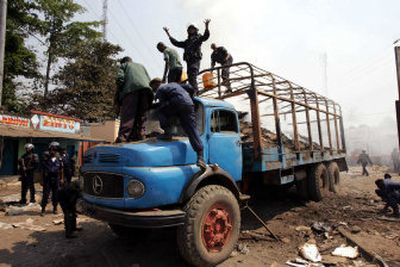
On Saturday in the central city of Mbuji Mayi, opposition militants attacked a truck carrying voting materials, setting it ablaze as they shouted “Nobody is going to vote!” and stoned police who fired tear gas.
The half-billion-dollar U.N.-supported enterprise is the world body’s biggest ever, safeguarded by the largest U.N. peacekeeping force in the world with 17,600 troops. Congo has been at the center of two multinational conflicts that came to be called “Africa’s World War.”
President Joseph Kabila, considered a front-runner in a field of 33 presidential aspirants, told thousands of supporters Friday he wants to improve conditions for Congolese, including building highways throughout the country and universities in the capital of each province.
That’s the hope, too, for the 25 million registered voters among the 58 million people in Congo, one of the world’s poorest nations despite its huge natural resources.
The violent eastern region is the site of one of the world’s worst humanitarian crises: Aid groups say about 1,000 people are dying every day from strife-induced hunger and disease.
Congolese hope a legitimate leader can plaster over the country’s divisions, pump up the economy and bring lasting peace to their nation.
“We need peace, development, justice and no more corruption. We’re fed up,” said Jean-Pierre Ifoma, a father of eight who like many Congolese is unemployed.
Ballots are pages long and have been shipped to 49,700 polling stations around the country. Nearly 2,000 international and 46,000 Congolese election monitors will scrutinize the vote.
Counting ballots from remote jungles and villages with no roads or electricity will not be easy, and first-round results may not be known for weeks. If no presidential candidate gains a majority, a runoff between the top two finishers will be held, likely in September.