
Dancers square off

Five years ago, Jim and Sharon Cline were settling into retirement. As with many newly retired couples, downshifting from full-speed into idle required some adjustment.
The Clines started looking around for things they could do together.
And they were open to suggestions.
“I had a friend who had been square dancing forever,” Jim Cline explained. “He said, ‘Why don’t you come down and try it? You only pay for every night you go, and if you don’t like it you don’t have to continue.’ We went down, we took a couple lessons and found that we liked it and we’ve continued with it.”
Continued is an understatement.
Square dancing got in their blood.
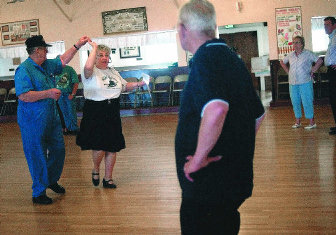
Friday and Saturday nights, the couple are at the Western Dance Center, 1901 N. Sullivan Road. On an average night, there are between eight and 10 squares of dancers – with eight dancers to a square.
Dancers come in all ages – from the youth dance group, the Spurs and Skirts, on up.
Doug and Betty Jones started square dancing at Colorado State University, and continued at the Western Dance Center when Doug was stationed at Fairchild Air Force Base in 1950. And they’re still dancing.
“We’re there at least one night a week,” Doug Jones said. “We used to be out there a couple nights a week, but we’re getting old. Now once a week is about all we can handle.”
“It’s a lot of fun – we really enjoy doing it,” Jim Cline said. “It’s great exercise, especially for your cardiovascular system. And we get to spend time with great people and have a good time.
“It’s energetic. It makes you think, because you have to listen to the caller and perform the move that he’s calling for. So it not only makes your body work, it makes your mind work as well.”
Square dancing is only half of what goes on.
Square dancing is done in groups of four couples, a beau and a belle, with a caller giving specific instructions to “stir the bucket” and “crash and burn.” A caller will put the square through a two-dance sequence, called a tip.
“After that you kind of need to take a little break, because you’re going to be pretty winded,” Jim Cline explained. “So then we’ll do a round dance. That’s more like ballroom dancing, but you’ll see some people out there who can really do some great moves, too.”
Round dancing is directed by a cuer and, as the name suggests, is done in a circle and is done in couples.
It takes time to learn the different calls for square dancing and cues for round dancing. The Western Dance Center starts lessons every October, with graduation in May.
And while many consider square dancing to be strictly a cowboy activity, its roots are in European folk dancing and comes predominantly from France. What most of us mispronounce as do-si-do comes from the French phrase “dos a dos.”
Influences include the gavotte, mazurkas, the schottische, the minuet and the Virginia reel – all dances done in squares and rounds. In fact, experts say, the only uniquely American aspect of square dancing is the addition of a caller to direct the action on the floor.
Wherever it comes from, square dancing is a regular part of the lives of its devotees.
Whenever the Clines feel the need to get away, there’s a square dance festival going on somewhere in the Pacific Northwest. This weekend the couple will be in Montana at a dance festival helping promote one of their own festivals.
That festival is at the Spokane County Fair and Expo Center on June 16 and 17, and is one of the Northwest’s biggest: the 55th Washington State Square and Folk Dance Festival, “Puttin’ On the Ritz.” More than a thousand dancers will gather for two days of square dancing, round dancing and clog dancing.
Tony Oxendine, from Sumtner, S.C., will be the featured square dance caller for the festival. Christina Corelli and Kirby Goode, from Eugene, Ore., will be featured round dance cuers. Dave Roe, from Surprise, Ariz., will be the featured clog dancing cuer.
The Joneses remember the 1960s, when there would be as many as 20 squares of dancers (160 people) on the floor at any one time.
“It was really big in those days,” Doug said. “It’s good to see that it’s still going on.”