
Iraq will investigate deaths of civilians
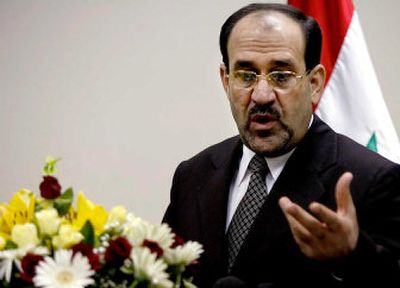
BAGHDAD, Iraq – Prime Minister Nouri al-Maliki announced Thursday that Iraq would conduct its own investigations into what he suggested were multiple cases of killings of civilians by U.S.-led forces, saying his government may demand greater restraints on foreign troops as a condition of their staying in Iraq.
A top U.S. general in Iraq, meanwhile, said the American military would embark within “a few days” on morals and ethics training for most of the roughly 150,000 multinational troops in Iraq, spurred by investigators’ findings concerning the alleged killing by U.S. Marines of 24 men, women and children in the western town of Haditha late last year and allegations of a coverup.
“The allegations of Haditha are troubling to all of us,” Army Lt. Gen. Peter Chiarelli, commander of U.S.-led forces in Iraq, said about the Nov. 19 killings.
“Whenever you have 150,000 individuals who are in a different environment and a different culture, an environment that can be dangerous at times, people will react differently at different times. I’d like to get it to 100 percent of our soldiers doing the right thing every single day,” he said.
Two U.S. military investigations are under way into the shooting deaths of 24 townspeople – including three women and six children, witnesses say – by members of Kilo Company, 3rd Battalion, 1st Marine Regiment. Iraqi witnesses and survivors, and U.S. officials briefed on the findings so far, say the Marines appear to have shot the civilians in cold blood after a roadside bomb attack on their convoy killed one Marine.
The Marines initially said 15 of the civilians had been killed in the bombing and that eight others, described as insurgents, were killed in fighting that followed.
Al-Maliki, head of a Shiite Muslim-led governing coalition that has at times expressed resentment of the U.S. troop presence here, formally condemned not just the Haditha killings but what he called “the practice” of occupying forces’ disregard for civilians in Iraq.
Under the U.N. charter, the U.S.-led coalition technically can remain in Iraq only at the invitation of the Iraqi government. Al-Maliki, while speaking sternly to an Iraqi public on the killings, stopped well short of saying the issue might lead to the foreign troops being asked to leave.