
Ex-Marine finds himself drawn to Islam, Iran

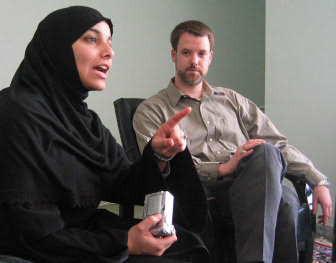
QOM, Iran – For centuries, disciples of the spirit have come to this desert shrine town in search of guidance, power or solace. Grand Ayatollah Ali al-Sistani studied at the seminaries here as a young man before heading off to Iraq and eventually becoming Shiite Islam’s most widely regarded scholar.
Ayatollah Ruhollah Khomeini, who lived here before his exile, returned to settle here among the bearded and turbaned clerics after leading the Islamic Revolution. Each day, thousands of pilgrims make their way here seeking spiritual nourishment at the blue-domed shrine of Fatima.
Robert Tappan, a towering former U.S. Marine from Torrance, Calif., is one of them.
“Even though I have the beard, I still get a lot of strange looks,” said the 35-year-old, whose light reddish-brown hair and 6-foot-3 frame make it hard to be inconspicuous.
After years of zigzagging between career paths and coasts in the United States, Tappan converted to Shiite Islam five years ago, saved up money and secured some loans. Last fall, he headed here with his wife, Sara, to make a spiritual connection with his newfound faith as well as finish his doctorate in Islamic Studies.
He has found himself struggling for answers about his new religion as well as his relationship to the United States in this conservative town, the religious center of a country locked in a war of words with Washington and the West over its pursuit of nuclear technology, its ties to militant groups abroad and its role in neighboring Iraq.
Tappan has actively stayed away from the more politically extreme elements of the faith. In Qom, he has befriended some of the most liberal and iconoclastic clerics, including Fazel Meybodi, recognized as a reformist who has questioned Iran’s rule by clerics. The two share an office.
“I don’t feel like the Iranian people feel like they are out for blood and they want to do anything to America,” Tappan says. “I don’t see Iran as the enemy at all.”
Tappan goes from serene and engaged to visibly uncomfortable and quiet when asked whether his presence in Qom could be interpreted as an approval of Iran’s human rights record and foreign policy.
“That’s like saying all the human rights activists who live in Iran should emigrate,” he says after a long pause. “Iran is so diverse, and all these schools of thoughts are here. You can’t put a blanket categorization on the people.”
But his journey to Qom has also disappointed him. In addition to piety and affirmation of his faith, he has found materialism, political expediency and traditions disguised as religion.
“I was hoping for something else,” Tappan says, “more profound.”
Tappan, who was born in Houston, moved to Southern California as a youngster. He tried various teen guises.
Disturbed by his own aimlessness, Tappan decided one day that he’d like to be a police officer, and to prepare for that, he joined the Marines.
“I had this idealistic view, I guess, of wanting to help the downtrodden and the poor,” he recalls. “Not like you have a mustache and be macho, but you could do cool stuff.”
The Marines had other plans for him. After basic training, he scored so high on aptitude tests that he was shipped off to the Defense Language Institute in Monterey, Calif., where he was placed in Arabic classes, much to his disappointment. “I thought, what am I ever going to do with that when I come out to be a cop in L.A.?” he recalls. “You know, I wanted to learn Korean.”
The introduction to Arabic would prove life-changing. The 1991 Persian Gulf War had just begun, and Tappan became fascinated with the debates percolating among his teachers about Iraq, the Palestinian issue and the problems of the Arab world.
A bureaucratic screw-up, he says, kept him from being sent overseas after his training, and he found himself repairing jeeps in Camp Lejeune, N.C. A bad shoulder got him honorably discharged after serving more than three years as a Marine, he says.
His intellectual curiosity piqued, he used his G.I. Bill money to get himself into the University of Redlands’ Johnston Center for Integrative Studies, in Redlands, Calif., where he took courses in religion and the Middle East.
Encouraged by his professors to enter academia, he attended graduate school at the University of Virginia, dropped out to become an animal-rights activist, and joined up again. Although raised by secular Protestant parents, he had become fascinated by religions.
“For whatever reason, Christianity never clicked with me,” he says.
At one point, he experimented with the idea of becoming a Zen Buddhist and attended a few meditation retreats, but he longed for a more personal connection to his faith. “I missed being able to pray or feeling like I had some kind of relationship with God,” he said.
He felt drawn to Islam’s calls for justice. He immersed himself in the differences between the dominant Sunni and minority Shiite sects. When Tappan felt the pull to Islam in early 2001, there was never any doubt he would go for the rebellious Shiites.
“I never discount the underdog,” he said. “My conversion was more of an intellectual arrival rather than some epiphany or some sort of mystical experience.”
At the University of Virginia, Tappan met Sara, a chatty Pakistani-American who had grown up in Latin America. They fell in love and married. After his conversion, Sara, a secular Muslim who melds her faith with her MTV sensibilities, started calling him “Ali Bob.”
Tappan, whose Muslim name is Irfan Ali, immersed himself in his studies, which combined his interest in religion and bioethics. It was his academic adviser and mentor, Tanzanian-born Shiite Abdelaziz Sachedina, who first suggested he go to Iran to study original texts.
After a year of bureaucratic dead ends, he and his wife got the OK to spend an academic year at Mofid University in Qom, which was established in 1988 by one of Khomeini’s associates.
The Tappans arrived at Tehran’s Mehrabad Airport in November. University officials took them from the capital’s hodgepodge of skyscrapers and tangle of traffic through the desert highway to Qom, about 80 miles to the south.
Tappan was given an office at the university and immediately set about with his studies: exploring the way Shiite Islam was grappling with weighty questions of bioethics such as in vitro fertilization, artificial insemination and surrogate parenting.
He was shocked to discover that he could bring up just about any topic with traditionally trained clerics. Is the withdrawal method a sanctioned form of birth control? Is it appropriate for a man to masturbate in order to produce semen for in vitro fertilization of his wife?
“We can ask even very blunt questions and people aren’t upset by them,” he says.
Although the heated discussions about politics, sex education and reproductive rights with clerics were intellectually stimulating, Tappan was spiritually uninspired. He was turned off by the government’s melding of politics and religion, with rallies on the grounds of the shrine complex and bombastic billboards of clerics-turned-politicians looking over city squares.
Then Robert Tappan had his moment of spiritual connection. It came one day when he spotted a cleric, deep in thought, walking along a trail on Mofid’s sprawling campus. Up above, the rocky reddish mountains almost swooned.
“I got more a sense of the holy just where we live,” he says during a drive through the city’s outskirts. “It is this beautiful, natural place. There’s this mosque up on the mountaintop. You see people going up there for pilgrimage. In some sense, I did find the holy – not necessarily where I thought it would be.”
He had hoped his trip to Qom would bolster his faith, but it inadvertently reaffirmed his ties to his own country. “Ultimately,” he says, “I realized how much of an American Muslim I am – and that’s OK.”