
Like AIDS itself, quilt’s role is changing
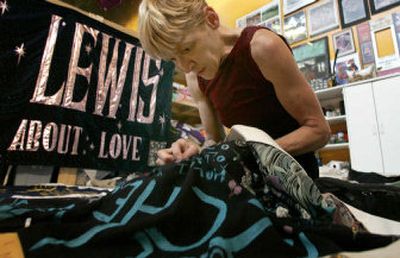
ATLANTA – She is constantly sewing. Hunched over pieces of the quilt, the seamstress stitches fraying edges and little tears that have accumulated over the years.
When she is finished mending a piece, she folds the fabric and carries it into a long, quiet gallery. Metal shelves stretch the length of the room.
Each shelf holds five 12-foot-square blocks of quilt.
Each block is made of eight panels.
Each panel, the size of a grave, contains a name.
“There are some spots that are really faded, that you can barely see anymore,” said the seamstress.
Here, in a corrugated-steel warehouse in Atlanta, lies the AIDS Memorial Quilt, the most powerful icon in the history of AIDS. In the 25 years of the epidemic, no symbol has managed to capture the sense of rage and loss like the quilt, born in a San Francisco backyard in 1987.
It brought the horror of the disease to America with both its vastness and detail – a patchwork the size of 24 football fields sewn from the artifacts of lost lives. It became the banner of the epidemic, shaking the government and priming the funding pipeline that has poured billions of dollars into AIDS research.
Today, the quilt largely is a museum piece.
The panels, which once arrived by the thousands each year, now trickle in at a few dozen a month. The more than 50 quilt chapters that once spread the word across the country have dwindled to 16. The NAMES Project Foundation, which oversees the quilt, has downsized to stave off bankruptcy.
While small sections are still loaned out each year to about 1,000 schools, charities and companies, the whole quilt – acres of fabric sewn to shame, alarm and remember – has not been rolled out in a decade.
“A lot of people think the quilt is out of business,” said Beth Milham, a 63-year-old retired nurse who still runs panel-making workshops near her home in Providence, R.I. “They don’t hear about it anymore.”
The quilt has gone the way of AIDS itself in the United States – swept into the background as new drugs have driven down the death rate here and shifted the epicenter of anguish overseas, where the disease kills 2.8 million people a year.
The foundation has become more a curator of history, shying away from the activism of its roots.
Executive director Julie Rhoad said the foundation welcomes all requests.
“If you are an activist and you want to use the quilt, that is your choice. If you are a teacher and want to educate, that is your choice,” she said.
But people who want to rekindle the fire of the past say parceling out the quilt for tiny displays is like letting a sword rust in its scabbard.
They point to the statistics: 15,798 deaths in the United States in 2004 and 40,000 new infections.”The people with the quilt have a weapon that they have decommissioned,” said Cleve Jones, 51, a prominent gay activist who conceived the quilt and made the first panel in 1987 for his best friend, Marvin Feldman.
On a parched afternoon in Palm Springs, Calif., Jones is watering the cactuses around his pool. Trim and handsome with closely cropped hair, he is more than a mere survivor of the disease.
He believes he contracted the virus more than 25 years ago from a casual sexual encounter. By 1993, his immune system was fading and he had lost 40 pounds. He moved to Palm Springs to die in peace.
But just months later, he enrolled in a clinical trial for a cocktail of three drugs. The virus has been kept at bay ever since. He is one of more than 1million people in the United States living with HIV.
On a blustery San Francisco night in 1985, Jones was shouting through a bullhorn at a crowd of demonstrators near City Hall who had gathered to mark the seventh anniversary of the murders of Harvey Milk, the first openly gay supervisor, and Mayor George Moscone.
Nearby, five men with AIDS had been chained to the doors of the federal building for a month, trying to draw attention to an epidemic that was largely ignored as a gay plight.
Jones handed out blank poster boards and marking pens. He told the demonstrators to write down the names of people who had died of AIDS.
They taped their placards to the building. Some signs simply read “My brother” or “My lover.” Jones gazed at the hundreds of posters on the wall.
He couldn’t stop thinking about it.
After his best friend died of AIDS, Jones cut an old sheet into a rectangle and laid it in his back yard. He spray-painted on five Jewish stars in pink and blue.
Jones saw a chance to touch Middle America. He advertised for volunteers. Gert McMullin, a department store clerk and self-described party girl who had watched dozens of gay friends wither and die, showed up the first day. She has been sewing ever since.
As panels poured in, the quilt was incorporated. A foundation was formed. Celebrities, companies and ordinary people donated money to the cause.
It took more than $3 million, but in October 1996, the whole quilt – then totaling 40,000 panels – was laid over the Washington Mall. More than 1 million people showed up. There were 20,000 boxes of tissues on hand.
“That weekend for me was the beginning of hope,” recalled Jones, who walked with President Clinton and the first lady through the sea of loss. He told the president that new drugs were beginning to revive people from their deathbeds but that more research money was needed.
The money flowed.
More than any factor, the drugs have transformed the quilt.
Introduced a decade ago, cocktails of antiretroviral drugs can keep patients alive for years, perhaps indefinitely. While millions of people still die overseas, in the United States, annual deaths peaked in 1995 at 51,000.
The desperation that had driven the growth of the quilt seemed to fade away.
New panels stopped arriving in large numbers, and so did the donations of $200 or more that often accompanied them.
Last year, the NAMES Project received 609 new panels – the majority of them for gay men who died in the 1990s.
The foundation today raises just a fraction of what it once did. Its budget of $1.2 million a year is enough to keep nine full-time employees to watch over the quilt. The quilt was moved from San Francisco to Atlanta in 2001 because rent was cheaper.
The quilt “has gone from an activist tool to a 54-ton albatross,” said David Gere, a professor at the University of California, Los Angeles, who studies the intersection of art and AIDS.
The foundation is at odds with its founder, who has pushed for using the quilt for political demonstrations. After Jones set out to prove that he could raise the money for a Washington, D.C., display before the 2004 presidential election, the foundation fired him as spokesman for the quilt.
Jones sued, claiming wrongful termination, and demanded that the quilt be put in receivership so that it could be returned to San Francisco.
“It’s abandoned,” he said. “It’s abandoned its purpose.”
The case was settled late last year. Jones dropped his claims and in return was given 35 sections of the quilt on a rotating basis once he sets up an organization to manage them.
Rhoad, of the NAMES Project, said there’s another political problem with showing the quilt – it doesn’t really represent the current face of the epidemic.
The quilt is an aging snapshot of the first decade of AIDS, when gay white men were dying in the tens of thousands. Today, the fastest growing groups of AIDS patients are minorities and women, many of them poor.
But just 616 blocks include panels for women, who now account for 27 percent of new cases. Only 260 commemorate black AIDS victims, even though blacks represent nearly half of new infections.
“There are a lot of people saying, ‘We don’t have time to do this. We’re just trying to survive,’ ” said Marita Sturken, a New York University professor who has written about the quilt and the politics of memorials.
Sewing panels in the middle of an epidemic is for the privileged, she suggested.
The foundation has been trying to get more panels for black women by holding quilting workshops in Atlanta.
Jones predicts that the foundation’s financial difficulties will lead to a return of the entire quilt one day. “When they fall, we’ll get it back,” he said.
McMullin worries that one day the quilt could end up in a museum or permanent storage. “I’m kind of afraid of a time when they would not need me,” she said.
There is one panel that she has set aside since its arrival in 1987. It is not for any AIDS victim in particular. “The Last One,” it says in bold white letters. In smaller print, it reads, “When the last one is named – WE WILL BEGIN TO HEAL.”