
Eye-opening irises

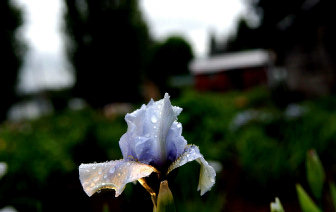
For Linda and Robert Karr of Newport, Wash., the iris season brings back many happy memories that have tied family, their marriage and now their business together for decades.
For Linda, the beautiful blooms bring back memories of helping her dad plant iris in Tekoa, Wash., when she was 8 or 9 years old.
“I kind of grew into it because he was interested in it, and when I married, my husband was very interested in flowers,” Karr said.
The Karrs started their own iris collection in 1962 and just “kept collecting and collecting and collecting. They are food for the soul,” she says.
Lucky for Inland Northwest gardeners, the Karrs’ hobby got out of hand enough that they now sell nearly 2,500 different varieties of iris at their Newport Naturals at Spruce Corner in Newport, north of Spokane. And now is a great time to go pick your favorite colors.
Few perennials have the range of colors, sizes or boldness that irises do.
“They are gorgeous,” said Karr. “A lot of people think it’s not worth the couple of weeks of bloom that you get, but we have found that, except for weeding, they aren’t a lot of work.”
On top of that, they grow in almost any soil, are not fussy about their care and are very disease and pest (including deer) resistant. The bearded irises are even fairly drought tolerant.
The Karrs grow eight different types of iris: Everything from the miniature bearded iris that get only a few inches tall up to the tall bearded ones that can get 3 feet tall, and several sizes in between. They also grow Siberian, spuria and Louisiana iris.
“Since we grow the ones from the very tiny to the big tall ones, we have a lot of variety in color, shape and bloom time,” Karr said. There is an iris for every sunny spot in the garden.
Their collection also includes 477 historic iris varieties, including one, Swerti, that dates from 1612. Historic iris must be 30 years or older to be classified as an heirloom variety.
Bearded irises are the most popular and widely planted variety. They are the perfect plant for Inland Northwest gardens.
The term “beard” refers to hairs that stand up on the top of the three drooping petal-like sepals, or “falls,” that hang from the base of the flower.
The smaller dwarf varieties start blooming in late April, and the taller varieties start in early June.
Bearded irises prefer well-drained soil of average fertility. They thrive on moderate to low water levels, making them perfect for dry spots at the back of a perennial border.
Siberian irises have smooth, thin, grasslike leaves and come in many clear, bright colors. They need a little more shade from the afternoon sun and also more water than the bearded iris.
Louisiana iris has smaller, tighter flowers than other iris. It comes in a wide variety of colors, including shades of red. In its native habitat, it grows close to ponds and bogs, so it would do well planted at the edge of a water feature.
This iris also appreciates a little shade from the afternoon sun.
“We do the Louisianas because they tend to have a very crinkled leaf and are quite tall,” Karr says.
Spuria irises can grow to nearly 5 feet tall with a wide range of colors. They bloom a little later than the bearded iris, so they can extend the iris show a little longer. Their blooms keep quite well and are a favorite of florists for corsages and arrangements.
They prefer moisture and some afternoon shade.
Almost all irises grow from a fleshy root called a rhizome. The rhizome grows right at the surface of the ground and actually projects a little above it.
The straplike leaves grow from one end of the rhizome. Each year the plant grows a new root, and the clump slowly expands and can become quite large.