
Ferns love gentle sunlight
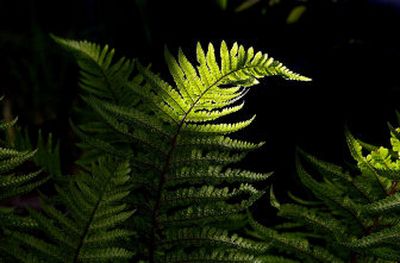
If you would like to grow healthy ferns in Spokane, you must pay careful attention to their growing requirements.
In their native habitat, ferns grow under conifers and small trees in a soil rich in organic matter with a steady moisture supply. That means they can handle some early morning sun but definitely need protection from the afternoon sun.
A yearly top dressing of compost is all they need for fertilizer.
They must be kept evenly moist through the growing season. My ferns are planted under some vine maple trees close to a sprinkler head, and I mulch their area with shredded pine needles to help keep the moisture in. It seems to work well.
Ferns are not troubled by any diseases or insects, and they are deer resistant. In the spring, they need no more than a cleanup of dead fronds to get ready to grow again. I usually just crumple the fronds and put them back as mulch.
Some ferns, like sword ferns, are semi-evergreen, so it doesn’t need trimming back until it dies on its own.
Ferns are a great addition to the shade garden. They add a soft, upright texture, with some varieties reaching 3- to 4-feet or more in height.
Their gently arching fronds are perfect for tucking smaller woodland plants under. In the fall, the fronds turn a soft yellow, lighting up the shadows around them.
They can be a bit slow coming out in the spring, so be patient and watch for the coiled stems called fiddleheads to emerge and unroll into the new fronds.
Here are a few good ferns for the Inland Northwest:
•Japanese Painted Fern (Athyrium niponicum “Pictum”) is a deciduous ground-hugging fern that grows about a foot tall. It spreads slowy with creeping rhizomes.
Its slightly arching fronds are an attractive silver green with purple ribs.
It does best in the front of a border where it can get some early morning sun and light shade the rest of the day.
•Lady Fern (Athyrium felix-femina) is a deciduous clump fern with lacy, slightly arching fronds. Its soft, green fronds can grow to 3 or 4 feet and are great grown with mounding hostas.
•Wood ferns (Dryopteria family) are a large group of ferns characterized by the classic stiff stalks that hold up finely divided, pale green fronds that can grow to two or three feet, perfect for the back of a border or under trees.
The native bracken ferns we see in the wetter parts of the region are part of this family. Two favorites in this family are the male fern (D. filix-mas) and autumn fern (D. erythrosora).
•Ostrich fern (Matteuccia struthioperus) is probably the tallest of the ferns we can grow here. Its deciduous, light-green fronds can reach 4 feet and have a softer texture than other ferns.
It can spread on underground rhizomes, not always a desirable trait.
Try it mixed in the back of a border with other ferns, rhododendrons and other shade-loving shrubs.