
Facelift broadens Spyder’s appeal
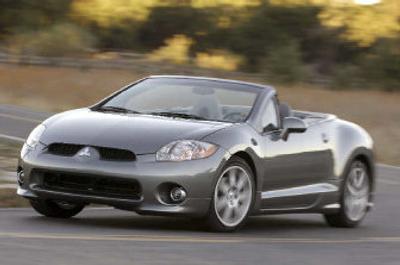
You’ll find a photo of Mitsubishi’s Eclipse Spyder under the heading of “Chick Cars” in the Auto Writers Guide to Cliché and Oversimplification.
But it’s time for a change, say I. For 2007, the Spyder has been refashioned into a smart-looking drop-top that would fit nicely into the manliest of garages.
If spinning heads and the dude on the bike who yelled “Nice car, man!” count for anything, the public is with me on this one.
The familiar curves and swoops that have earned the Spyder the chick-car sobriquet have been toned down, cleaned up and repackaged for more adult — and more male — tastes. Young women won’t abandon it, but the redesign is certain to broaden the Spyder’s appeal.
Mitsubishi calls its fourth-generation Spyder the “attainable exotic,” which overstates the case ever so slightly, as the term is usually reserved for cars higher on the food chain than Porsche’s Turbo Carrera.
But never mind; the Spyder is a pleasant 2+2 convertible with a comfortable cockpit, some of the prettiest lines found on a sub-$30,000 runabout and a fully automatic, canvas roof that folds neatly away under a body panel.
The latter is the kind of touch that until recently could be found only on cars costing thousands more than the Eclipse.
The Spyder occupies a kind of automotive no man’s land, competing against such disparate vehicles as the Ford Mustang, Chrysler PT Cruiser and Toyota Solara. Some pundits try to slip the Nissan 350Z into this crew, but the match doesn’t work; the Z is too much of a sports car to be lumped in with this group of boulevard cruisers.
Built on Mitsubishi’s robust new Project America platform, this is the most rigid, stable and best-riding Spyder to date. Tipping the scales at 3,693 pounds, it’s no lightweight, but that’s the penalty imposed by the extra bracing that gives the topless unibody the rigidity required of a contemporary convertible.
The effort pays dividends on rough roads and across railroad tracks, where cowl shake (the feeling that the steering column is shuddering in one’s hands) has been reduced to acceptable levels.
The tauter structure also allows for finer suspension tuning, which in the Spyder translates into a markedly improved ride. Neither driver nor passenger will suffer the kidney-rattling experience some sports cars produce — or even by one or two of its own predecessors.
On the other hand, it doesn’t come near duplicating the handling characteristics of a sports car.
The Spyder is available in two trim levels. A 162-horsepower, 2.4-liter four powers the base GS (from $26,014 including destination) and is paired with a five-speed manual transmission or an optional four-speed automatic with manual Sportronic mode.
The up-level GT trim (from $28,894) gets a 3.8-liter V-6 that makes 260 hp and can be had with either a six-speed manual or five-speed Sportronic automatic.
I haven’t driven the GS, but it’s said to be somewhat underpowered.
The GT is hardly underpowered, but the six is a heavy, iron-block affair that locates 60 percent of the Spyder’s weight over the front wheels. Predictably, the GT understeers badly when driven hard into a corner.
Torque steer is another concern; 260 hp pushes the limits of what even a sophisticated suspension can handle. Lay hard on the GT’s throttle, and the car pulls hard to the right.
Best to slow down, put the multi-layer fabric top away and enjoy the sunshine.
Dropping the top requires opening two latches and pushing a button. Nineteen seconds later, it and its glass window, with defroster, are neatly stowed away. Cabin turbulence is minimal and with the optional wind-blocker in place, conversation in normal voices is possible even at freeway speeds.
If you don’t want to talk, the standard, Rockford Fosgate audio system provides exceptional sound, even compensating for the special acoustical requirements of the top-down experience. Don’t expect to plug in your iPod, though; the plumbing doesn’t exist yet.
The interior is essentially stock Eclipse, which has taken a decided turn for the better this year, with upscale materials, good fit and finish and a well-arranged assembly of gauges and controls.
What is a small rear seat in the Eclipse coupe becomes nearly nonexistent in the Spyder, due to the space-eating requirements of the top and its associated hardware. Even a pair of child seats will tax this seating area; better to consider it a parcel shelf.
Rearward site lines are obstructed by the soft-top’s broad C-pillars and the rear window is too small to be much help during lane changes. So be careful out there.
It’s been fun to watch the Eclipse mature over the years. At one time its peaky, turbocharged four-cylinder engine would overwhelm the chassis, creating a loosey-goosey, torque-steering little fire-breather.
The new-generation Spyder is a handsome, well-executed ride for two whose new face will have guys clamoring for their turn behind the wheel. It’s only fair; girls shouldn’t get to have all the fun.