
Ex WV standout narrows focus
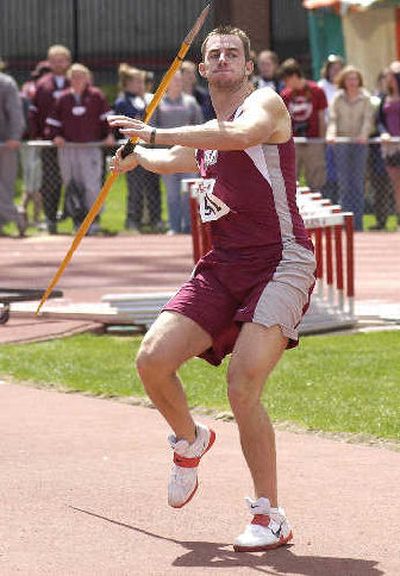
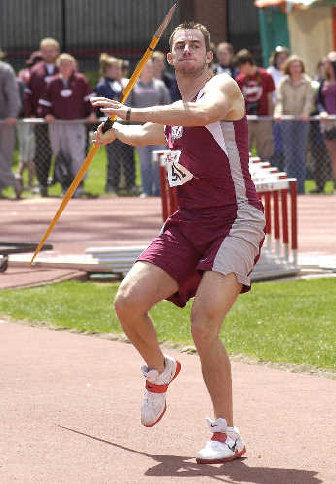
It seemed that Jon Jeffreys did everything during his career at West Valley High School.
Tall and lanky, Jeffreys was the quarterback and captain of the football team.
As a 6-foot-5 1/2 post, he led the Greater Spokane League in scoring and led the Eagles basketball team to the State 3A Tournament.
He played baseball his sophomore and junior years before switching to track his final spring, setting a school record with a javelin throw of 197 feet, 3 inches and placing third in the State 3A track meet.
Along the way, he earned nine varsity letters.
Now, after two seasons at Washington State University, Jeffreys does one thing and concentrates on doing it to the best of his abilities.
Although it comes as a surprise to those who watched him during his prep career, what Jeffreys does now does not involve a ball.
“When I came out for track and started throwing the javelin, I liked it,” Jeffreys said. “There was a learning curve.
“I pretty much had instant success with it, and everyone likes success. Pretty much fell in love with it right then and there. It’s what I wanted to do.
“My first year here, it took some adjustment. When I was in high school, I did so many things and kept so busy, it was a change to be concentrating on just one thing.”
In those other sports, there were so many more opportunities to perform.
“With football there were games every Friday night,” he said. “With basketball we would play two and three times a week. It was an all-year thing.
“Between all the sports I did, I must have played about 250 games in my high school career – even more when you figure in summer basketball leagues and everything else. Now I work all year to prepare for about 12 track meets.”
That’s not to say he doesn’t miss his old sports.
“I still miss basketball,” he admitted. “But this is OK, too.”
After a freshman season focused on the fundamentals of his event, Jeffreys exploded onto the national scene this spring, uncorking a throw of 226-2, the 17th best throw of the season and the best by a Washington State thrower all year – the eighth best in school history.
But it was costly.
“I hurt myself on that throw,” he said. “I strained a bunch of rib cartilage, and I was out for two and a half weeks, and I wasn’t right for about a month. It got me out of my swing.
“I had been really in a groove there when I got hurt and had been throwing really well. I started to get back into that groove about three-quarters of the way through the season.”
Jeffreys earned a trip to the NCAA track and field championships in Sacramento but failed to get out of the qualifying round, throwing 197-8.
“I was disappointed with the way I threw down there, but at the same time it was a good thing for me to experience,” he said. “If I hadn’t gotten there, I’d be working all through the summer and fall to get to the regionals.
“Now, I’m working to get back to the nationals. It raises the bar.
“And it was good for me for next year, too. Next time I go down there, I’ll know what to expect. And I’ll know how to prepare for it.”
The biggest shift for Jeffreys has been mental.
“I’ve had to dial back my intensity,” he said. “You can’t psyche yourself out like that.”
As a high school athlete, he relied on his natural athleticism and his ability to compete to get by.
“I could always reach down and just be more aggressive and have success,” he said. “The javelin is just the opposite. You have to relax to get into the throw.
“Before I got here, and even for part of last year, I would just rely on my arm and try to heave it out there. That doesn’t work, and it ends up hurting your arm.”
Jeffreys said the javelin is technically demanding. “Throwing the javelin is not a natural act. You have to rely on your body and allow your arm to be a whip.”
Jeffreys plans a summer of hard work in the weight room and on increasing his flexibility.
“It’s a battle to stay healthy because the javelin is really hard on the body. It throws your arm out, your back, your legs, your ribs.
“And you have to learn how to not burn yourself out during the off-season. You have six months there where all you’re doing is training. You have to stay fresh.”