
Journal showcases young scientists’ work
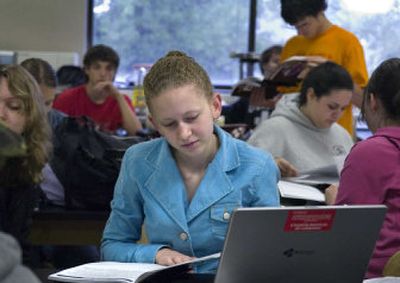
In Brent Osborn’s two sophomore honors science classes, it’s hard to tell the professional scientists from the students.
The distinction became even fuzzier with this week’s release of the second volume of the North Central High School Journal of Science.
About 60 students spent a year using the 104-acre Pinecroft Natural Area Preserve in Spokane Valley as their classroom, collecting samples and data, and asking questions. The result is a publication with 23 research projects that rival work completed by professional researchers.
“I think it’s a great opportunity for people to see what kids can really do – this is really a high-level product,” said Doug Sutherland, the state commissioner of public lands.
In recent years, the North Central science program has been dedicated to promoting more hands-on learning, including publishing the research of students.
“Students doing authentic research is rare in any high school,” said Randall James, a teacher who served as an editorial advisor for the journal. “But to have two classes of sophomores doing it at the same time is unheard of.”
After visiting the nature preserve, tucked next to the Spokane Valley YMCA and managed by the Department of Natural Resources, students came up with a list of 10 questions. Based on their inquiries, they were put into groups and formulated a single research question.
Some of the analysis includes the feeding behavior of Bubo virginianus (commonly known as the great horned owl), the effects of noise pollution on habitat, and the mortality rate of trees.
Aaron Sandaker, 15, and classmates Tim Matthews and Garrison Rodrigues wrote an analysis of the industrial impacts on Pinus ponderosa. They collected core samples from 10 different trees, and determined that industry may have slowed the growth rate of the conifers.
“It’s amazing to be recognized,” Sandaker said. “It makes me want to continue my research, and go on to experience more.”
Student Jessica Harris, 16, helped with an analysis of fire dangers and the fuels located on the public land. Her group, including Ryan Dickens and Robert Wheeler, used their data to create a fire simulation to determine how quickly a fire would spread through the natural area.
“This is a professional journal, which is out in the science community and people can look at it and learn from it,” Harris said. “This is the best science class I have ever taken.”
Osborn hopes to keep publishing the journal each year, which depends on funding.
Osborn received funding from a variety of sources for the work, including a Toyota Tapestry grant, a grant from the M.J. Murdock Charitable Trust “Partners in Science” program, and funds from the ING financial group. Itron donates the money for the publication of the journal itself.
In two years, he has spent a total of $30,000 on the journal. Not to mention the countless hours he’s spent editing the students’ work and providing transportation outside of scheduled field trips to collect samples.
“Sometimes people have a preconceived notion of what our kids can achieve,” Osborn said. “I’m so proud of them. They end up showcasing their skills to everyone and themselves.”