
Bush arrives for EU talks
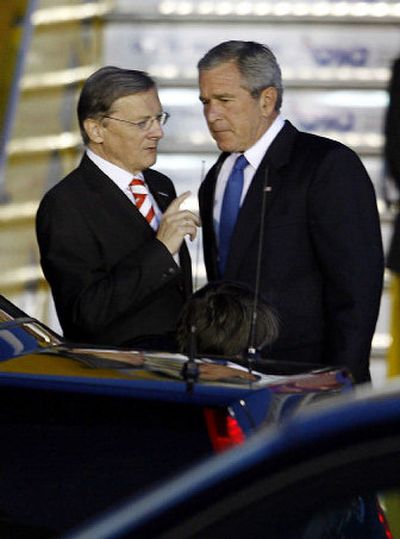
VIENNA, Austria – President Bush stepped off Air Force One on a warm night Tuesday in the heart of central Europe and into the hot debate over the U.S. war in Iraq and his administration’s tactics in countering terrorism.
He began a 21-hour visit to Austria, built around a meeting with the leaders of the European Union, as the United States and its allies await Iran’s response to their latest anti-nuclear proposals. Bush also plans a similar quick stop in Hungary today and Thursday.
The president arrived with what his national security adviser, Stephen J. Hadley, said were three goals: “Promoting freedom and democracy, enhancing security, and pursuing greater global prosperity.”
The goals draw little debate; the means to achieving them are tearing at the European political and social fabric.
While the United States’ agenda with Europe covers global trade negotiations, European farm subsidies and Iran, Austrians want their leaders to confront Bush’s policies in Iraq, the U.S. prison base at Guantanamo Bay, Cuba, and the rendition of suspected terrorists to countries that permit torture.
Newspapers and television talk shows have discussed little else in recent days with people at both ends of the political spectrum deploring the treatment of terrorism suspects who have not been charged with a crime.
Austria’s widely read news magazine Profil featured Bush on its cover this week, under the headline: “The Mad World of George Bush.”
“What makes the leader of the last superpower tick? Just how fanatical is he?” the magazine asked. In the city of Freud, it drew a deeply unflattering psychological profile of the president, under the headline “Bush on the Couch.”
The visit to this officially neutral country is the first by a U.S. president since Jimmy Carter met Soviet leader Leonid I. Brezhnev here in 1979 to sign a major arms control treaty. Bush will meet with Chancellor Wolfgang Schuessel, the EU president.
Austria is the 54th country Bush has visited as president; Hungary will be the 55th.
The stopover in Budapest will give Bush an opportunity to commemorate the unsuccessful uprising by Hungarian partisans against Soviet domination in 1956. The revolution foreshadowed the disintegration more than three decades later of Communist rule across Central and Eastern Europe and provides the U.S. leader a metaphor for the broader democracy that he has promoted as the underpinning of his policies toward the Middle East.
Bush also is making a renewed push to get those who have promised to help rebuild Iraq to begin paying up. Of the $13.5 billion in assistance that has been pledged, he said Monday that only $3.5 billion had been paid.
While large amounts are due from Iraq’s wealthier Persian Gulf neighbors, Europe also owes money, Hadley said last week.
The meeting with the EU leadership has been long scheduled, but its timing allows the president to promote a united front to pressure Iran to suspend enrichment of nuclear fuel, which the Bush administration sees as an immediate problem.
The five permanent members of the U.N. Security Council – the U.S., Russia, China, France and Britain – and Germany offered Iran a package of incentives early this month to persuade Tehran to halt its nuclear program. Since then, Iran has been lobbying hard to soften the terms so that it can continue some uranium enrichment as “research and development.”