
Portable toilets in demand
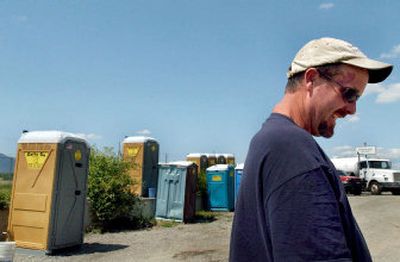
With crowds gathering at Spokane’s Hoopfest and Coeur d’Alene’s Ironman triathlon this weekend, the companies that rent and maintain portable toilets find themselves flush with success.
Those firms say they’d normally have enough units for the busy weekend, but the regional construction boom has left portable toilets in short supply.
For the past two days Doug Corn has been busy assembling more than 70 new units at his Hayden company, Gotta Go Portable Toilets.
Most of those will be rented to another area firm, American On-Site Services, which is scrambling to find more than 300 portable toilets for Hoopfest and for Ironman.
“We’re dealing with those special events right now,” said Corn, referring to Hoopfest and Ironman. “Plus, I bet you there are 20 big weddings going on this weekend and we have to provide for them, too.”
Even so, he knows the pressure has come from the bustling construction industry. “One-half to two-thirds of our 700 (Gotta Go) units are out there on construction sites,” said Corn. “That’s what’s really driving all this.”
He and his wife, Sandra – who runs the company’s Spokane Valley office – started Gotta Go seven years ago. They charge around $75 per month per unit.
The company renting units from the Corns this weekend, Spokane-based American On-Site Services, is the largest local provider of portable toilets, said Michelle McInnis, the firm’s route manager.
It will provide 225 units for Hoopfest this year, along with roughly 120 for Ironman, she said.
Even with a growing inventory of 1,500 portable toilets around Eastern Washington and North Idaho, the company had a challenge handling this weekend’s rush, she said.
While many units are sitting idle this weekend on construction sites, few of those toilets are in good enough condition to be used at public events, said Sandra Corn.
“Once a toilet has been used on a construction site, you don’t want to put it anywhere but a construction site. You wouldn’t take one of those toilets and send it to a wedding,” she said.
Summers are the peak season for the portable toilet industry, said Steve Barger, president of Puyallup-based Northwest Cascade Inc. The company’s Honey Bucket division rents about 1,200 units around North Idaho and Eastern Washington.
“This year it’s as large as it’s ever been,” he said, citing the strong construction boom and a flurry of community events. “We’re seeing a lot of festivals, food fairs and large weddings adding to the demand,” Barger said.
Finding and delivering units is one challenge; maintaining and cleaning them during a busy weekend is another, said McInnis from American On-Site.
During the weekend, crews will visit the portable toilets, replace toilet paper and check on sanitation. Each weekend evening another crew will come to the sites to pump out the waste and “refresh” the toilets.
“We’ll have about 30 people doing that, working until midnight,” said McInnis.
The outdoor toilet industry has even hired university researchers to determine the most efficient way to schedule cleaning and maintenance, said Ron Inman, the Honey Bucket director for Washington state.
Companies figure they can count on one unit per every 10 workers on a construction site and clean it once a week, Inman said.
“You’d never want to go that long anywhere else, like at a big public event,” he added.
Companies like Honey Bucket and American On-Site are also dealing with longer delays in deliveries of new units as portable toilet manufacturers have been stretched thin meeting demand, especially from faster-growing areas.
“There’s been some shortages, but most of that is due to the Katrina effect,” said Inman.
“These units rely on petroleum-based plastic products,” he said.