
Connecting Portland

PORTLAND – To follow the tourist track in Portland, hop on the streetcar.
Sometimes visitors don’t want to be around other tourists. But if you’re new to this town or just looking for an easy weekend visit, the Portland Streetcar puts you on track to an entertaining cross-section of the river city.
From the trendy boutiques in converted bungalows on Northwest 23rd Avenue, to the hip-hype culture of the high-rent Pearl District, to downtown and the user-friendly riverfront, the streetcar route covers what you might call Portland’s Greatest Hits.
And for a visitor there’s security in knowing that the modern, Czech-built streetcars run on only one, crosstown line; tourist maps show the route, so it’s tough to get lost.
Locals like their streetcars, too. In the BridgePort BrewPub, in an old industrial building sandwiched between two spurs of the streetcar line on Northwest Marshall Street, I found friendly lunchmates in Brendan and Lisa McGillicuddy, transplanted East Coasters who’ve lived two years in Portland.
They’d come downtown on a recent Saturday to take in an exhibit at the Portland Art Museum. When they first moved to Portland, they lived near the streetcar on the northwest edge of town.
“It was great. I could hop on the streetcar, then change to MAX (light rail) and be at the waterfront for a festival in 10 minutes,” Brendan said as he sipped a pint of India pale ale.
MAX, short for Metropolitan Area Express, began running light-rail trains in 1986. With 38 miles of track it now quickly connects downtown to the suburbs.
Portland’s streetcar debuted in 2001. On six miles of track back and forth across the central city, weekday ridership last fall reached 9,000 people per day.
From an original line connecting the Northwest/Nob Hill district to Portland State University, tracks were extended last year to the RiverPlace complex of hotels, restaurants and shops on the Willamette River.
This summer, a spur will link to new offices and condos south of the Ross Island Bridge, where construction is under way on the third feather in Portland’s transportation hat-trick: an aerial tram that will soar over Interstate 5.
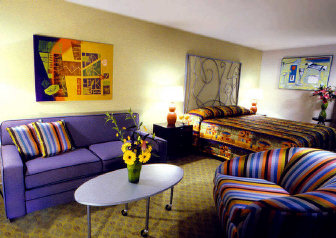
Portland even has a hotel designed especially for streetcar riders. The Inn at Northrup Station, with its own streetcar stop, was the perfect base for our weekend of streetcar touring.
With garish, futuristic-kitsch decor apparently inspired by the “Jetsons” cartoon (the “housekeeping requested” door hangers read “Ready for Rosie”), the three-story hotel provides free streetcar tickets to guests.
From the inn at Northrup and 21st, it was an easy walk to find restaurants and shops in the Northwest/Nob Hill neighborhood.
For a quick lunch, we ducked into Northwest 23rd’s Escape from New York Pizza – an old hippie dive that survived gentrification – for thin slices so big they took two hands.
Across the street, our 14-year-old found diversion in a shop called Wham!, Portland’s wacky answer to Archie McPhee. Up the block, dessert on the go was from Moonstruck Chocolates, where cinnamon-dusted Mayan truffles were $2 apiece and worth it.
From one end of the streetcar line to the other is 25 minutes. After Nob Hill, next stop is the Pearl District, about a 60-square-block area north of downtown that was a no-man’s-land of decaying warehouses until developers got hold of it in the early 1990s.
The district is still growing condos as fast as cranes can lift steel, and the streetcar has played a big role in drawing residents and shoppers.
Atop one modern building is a spoof on the decades-old “Go By Train” neon sign atop nearby Union Station: Here a similar sign reads “Go By Streetcar.”
Jamison Square offers a focal point for new towers of glass intermixed with historically preserved brick low-rises. Bordering the square, modern totems – artworks called “Tikitotemonikis,” by sculptor Kenny Scharf – cast pink, green, aqua and purple leers at passing streetcar riders. In warm months, there’s an interactive fountain for kids.
Like tax-free shopping? The Pearl is your oyster. It’s home to more than 60 home-furnishing stores and galleries. Restaurants are a mix of posh (the French-accented Fenouil on the square) and down-home (Glisan Street’s cozy Byways Cafe, specializing in fancied-up comfort-food), with plenty of other eclectic choices in this city that was recently named America’s most vegetarian-friendly.
Typical businesses along the streetcar’s 11th Avenue tracks:
“A martini bar called Olive or Twist;
“Eastwest Fusion, “Zen for your home,” where you can accessorize that million-dollar condo;
“Nirvana Apothecary and Day Spa;
“ Desperado, a “contemporary and nostalgic” Western Store, which means you can pick up an $850 Greeley Hat Works cowboy hat that would have done Gene Autry proud, or skull-embossed cowboy boots that Jerry Garcia could have loved.
A gallery worth finding: Bullseye Connection at 13th Avenue and Everett Street, which showcases artwork made of glass from Portland’s renowned Bullseye Glass Co.
Unlike the blown glass Puget Sounders know from Tacoma’s Dale Chihuly, Bullseye artworks are often two-dimensional, using kiln-formed glass to create panels with electric colors, in textures ranging from bubbly to sandy.
“People from Seattle tend to come in here, look around and say, ‘Where’s the glass?’ ” says gallery staffer Rebecca Rockom.
Also uniquely Portland is Powell’s City of Books, a bookstore filling a block flanked by streetcar tracks. It’s unusual because (a) it’s huge, and (b) it sells as many used books as new. It’s a bargain-hunter’s wonderland.
Inside, the World Cup coffee shop and tea room lets you sip a pot of Earl Grey while you dive into the latest mystery.
Hop the streetcar a few more blocks to downtown and get off by Portland’s Central Library at 11th and Taylor (the entrance is on 10th).
The restored 1913 edifice with grand staircases and chandeliers is another Portland yin to Seattle’s yang.
Where would you rather spend an afternoon, at the ultra-modern library in downtown Seattle or the historical library in Portland, my wife asked our daughter.
“Oh, Portland!” our daughter exclaimed. “It’s a beautiful library! The one in Seattle makes you feel like a pod person!”
Inside, don’t miss the imposing bronze tree sculpture in the Beverly Cleary Children’s Library, named for the Henry Huggins creator who lived here. Like initials carved in the bark, images from fairy tales and children’s stories climb its trunk.
To further delight children and the childlike, meander around the corner on Yamhill Street to Finnegan’s, Portland’s extraordinary, locally owned toy store, where you can get anything from wind-up walking sushi to a “Star Wars” version of the game of Risk.
The streetcar’s southern terminus is a work in progress. A new Marriott huddles in troll position beneath a freeway bridge. Construction cranes dot the riverfront like herons on a mudflat.
Along a mostly neglected shoreline near the future aerial-tram terminal, I met a local couple who’d strolled down to look at the new development. It includes buildings for Oregon Health & Science University, whose nearby hillside campus will connect to the river via the airborne tram.
The pair had just come in from renting kayaks at RiverPlace. They liked what they saw.
“A city needs to be vital, and that means change,” said Allen Burrell, a lifelong Portland resident. “It’s nice to see something being done with this area.”
“I think this will give Portland a new focal point,” added his companion, Gerda Eck. “I’m originally from Switzerland, and I like cable cars.”
At nearby RiverPlace, we passed up kayak rentals and instead rented a classic-style tandem bike, with big handlebars and whitewall balloon tires.
For an hour, my daughter and I pedaled Portland’s waterfront paths, crossing bridges to both sides of the river, dinging our bell as we weaved among pedestrians, skaters and other cyclists, looking out at a waterway crowded with tour boats, a historic sternwheeler, kayaks, canoes and even a submarine (moored at Oregon Museum of Science and Industry).
Yep, there’s lots to do and see in Portland. Just hop on the streetcar and you’re there.