
Army reservists heading back to Iraq
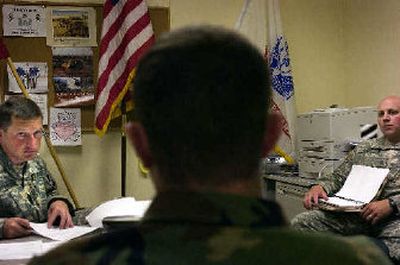
U.S. Army Capt. Jason Johnson has seen the sweltering sands of Iraq firsthand.
Master Sgt. Vernon Vanderhoef was injured while waiting to move into the war zone – and still spent nearly a year in the desert.
Sgt. David Hee stood watch at Iraqi checkpoints, never knowing if a vehicle rigged with explosives was heading his way.
Yet each man has volunteered to go back to Iraq this year.
The U.S. Army Reserve soldiers are three of 100 who make up Bravo Company of the 321st Combat Engineer Battalion. The Hayden Lake-based company will spend 12 to 14 months around Ramadi, Iraq, a war-torn hot spot where insurgent forces have escalated attacks in recent months.
But this story is not about bad news or troops lamenting a stint in a deadly country. The soldiers say they’ve heard enough of that. The three say they decided to step back onto the battlefield, both for their country and to guide younger soldiers who will be having their first war experience.
They depart for training in Wisconsin after a ceremony next month at the Army Reserve Center in Hayden Lake.
The men believe they can have an impact on younger soldiers who will be deployed with them, and they hope to use their experience to make sure the mission goes as planned.
“Mainly there’s a drive inside. I just want to be outside with those guys,” Hee said
They go despite past threats to their lives, or injuries, or the fact it may be time to “hang up the boots,” as Vanderhoef put it.
Johnson, a Coeur d’Alene resident, will return despite a nearly-fatal encounter with a grenade that landed at his feet. “Even still, I want to go back,” he said.
Johnson, 32, has been in charge of Company B since last September, after he had finished his service tenure and was called again, for a leadership position. It was an unforeseen offer for Johnson, who met his fiancée, Jamie Caine, only 10 months prior. He had thought he was done with the military.
“I actually sold all my Army gear four days before,” Johnson said of the surprise call. “And for like 30 bucks.”
But the offer was a chance to lead soldiers, who are some of his favorite people, he said.
“I love the field. I love the Army,” Johnson said.
That made it easier to again accept the risks that come with battle, he said.
Johnson spent 2003 in Iraq during the initial wave of invasion. He manned an Abrams tank as the second in command of a 10-tank company backing an Army infantry division.
On the day the statue of Saddam Hussein came toppling down in south Baghdad, Johnson and the other tanks were battling the remnants of the dictator’s army on the north side of the city.
His service in the early days of the war earned him a Bronze Star for valor in battle. He is grateful that the fighting left him uninjured – not that he didn’t have some close calls.
Rocket-propelled grenades are a favorite weapon of insurgents in the city, Johnson said. It was easiest to tell if he was being attacked by the plinking sound of bullets bouncing off the tank and the whizzing, looping smoke trail of an RPG coming toward him.
The manic behavior of RPGs happens because attackers try to stay far away while firing the unstable short-range weapon, he said. But RPGs often are successful in hitting targets, like the one that lodged inside his tank.
The grenade zinged straight up in the air, shot back down, entered the loading hatch of his tank, then curved and lodged beneath his feet. Johnson said he doesn’t know why it didn’t explode. The point is he’s alive.
Another grenade came within inches of his head, demolishing a wall in an alley he drove down.
Still, he wants to go back, although he admits it will be different than driving the behemoth of a machine he controlled before.
“I miss my tank,” Johnson said, sitting next to a shelf where his old blue flame-flecked tanker’s helmet rests. “Driving a tank is like driving a Cadillac. It’s so smooth, powerful. It’s a great feeling.”
Mended and ready
Vanderhoef, who lives in Coeur d’Alene, was injured in a 2004 training exercise while stationed in Kuwait, awaiting orders for his unit to move farther into Baghdad.
Anti-inflammatories and basic checkups were the only medicine he sought for 9 1/2 months after falling on his arm and severely jamming his shoulder. He spent that time hauling fuel for vehicles in Iraq with the 737th Transportation Company, based in Yakima.
When Vanderhoef arrived back in the U.S., he had rotator cuff surgery. Retirement seemed ideal after nearly 25 years in the service. But then he was offered another go-around.The 44-year-old was even more inspired for another stint after reading about an officer who lost limbs in battle and still went back to lead troops in Iraq. His shoulder injury seemed minor after that.
“At least I’ve got both legs and arms,” Vanderhoef said. “If they can do it, I can do it.”
The shoulder is mended now, he said, and his experience will serve as an indispensable tool for younger soldiers.
“They voice concerns. You know, they haven’t been in for more than five or six years,” he said. “I guess they’re fishing for knowledge.”
Staying on mission, as each leader called it, will help junior officers and young men in the company focus on the task at hand, not the “what-ifs,” Vanderhoef said.
In it for life
Hee, 25, joined the battalion in February and lives in Bellingham, Wash., to be close to his family. When his mother retired and moved to the mainland from Hawaii, he followed, and became a part of the 321st.
Seven and a half years in the military – he joined after high school – have inspired him to remain a career soldier.
He first went to Iraq in March 2004, serving with the 411th Engineer Battalion out of Honolulu. Some of that time was spent in an administrative role. Then he helped a Catholic Army chaplain travel around conducting services. His job also included manning checkpoints around Camp Liberty, the area known for Abu Ghraib prison.
Hee said he volunteered to return to Iraq because it would help him hone his military skills and increase his opportunity for advancement. He said he’s committed to remaining with the country’s largest fighting force.
“Basically I’m a lifer,” Hee said. “I’ll probably stay in 20 years, provided my body stays in there.”
Like the other leaders, he is a believer in the team effort of soldiers.
Hee volunteered despite the worry of his mother and the attacks his camp faced daily. Insurgents would bombard the camp with mortar attacks, and he said Americans don’t realize how often grenades are tossed over base walls.
“It can get pretty intense,” he said. He counts himself lucky to not have had to deal with a vehicle-borne explosive device. Insurgents would rig vehicles to work as unmanned kamikaze devices, exploding at checkpoints. He said it was rare that one ever made it to a checkpoint, and it never found his. But the explosions were heard often, Hee said.
Each soldier said he will miss home. But Johnson said that compared with previous wars it’s easier now to keep in touch with family and friends, thanks to e-mail and better phone technology.
Hee said he tries to take in each moment until the battalion is deployed in July. U.S. weather and green grass are a joy to him, because in Iraq the temperatures go to extremes.
“Although the news says it’s going to be hot, it’s nothing compared to Iraq,” he said. “It’s the kind of stuff I savor.”