
Papers implicate Saddam in killings of 148
BAGHDAD, Iraq – Prosecutors in Saddam Hussein’s trial on Tuesday presented documents for the first time linking the former dictator directly to the executions of 148 people.
The documents were at the heart of the prosecution’s case during Tuesday’s two-hour court session. Saddam and his seven co-defendants are charged with killing 148 in the northern Shiite Muslim city of Dujail after a 1982 assassination attempt on Saddam there.
Jaafar Mousawi, the chief prosecutor, spent nearly the entire session reading one document after another. The memos and letters link Saddam and two of his co-defendants, former intelligence chief Barzan Ibrahim al-Hassan and former Iraqi chief Judge Awad Bandar al-Bandar, to the executions.
In one document, a June 1984 order, Saddam’s signature appears at the bottom of a list of the 148 Dujail residents who were rounded up and charged after someone shot at the former dictator’s convoy as it passed through the city. The document says they should be hanged.
Another document shows that 96 of those listed in Saddam’s order were executed March 23, 1985. Another 46 died under torture during interrogations, Mousawi said, and two escaped. The remaining four were executed by mistake.
Ten of those charged were teenagers, who were executed by 1989, before they reached legal age, Mousawi told the court.
The prosecution charged that Saddam had signed off on allowing the intelligence agency to bury executed children.
In one letter, an intelligence officer wrote: In 1985, “it was discovered that the execution of 10 juveniles was not carried out because their ages ranged from 11 to 17 years old. We recommend executing them in a secret manner in coordination with the management of the prison and the intelligence agency,” which al-Hassan led.
The prosecutor said that Saddam had drawn an arrow from this paragraph to the margin and written “yes.”
“It is preferable that they are buried by the intelligence agency,” the letter says.
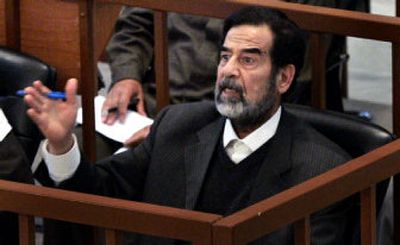
Saddam appeared subdued and tired, apparently from his 11-day hunger strike. He and other defendants spoke out far less than usual. Only once did the judge tell one of the defendants to keep quiet.
Until Tuesday’s session, the prosecution’s case largely was built on witnesses who gave graphic descriptions of what the government had done to them after the assassination attempt but couldn’t provide any evidence linking themselves to the defendants.