
Tradition
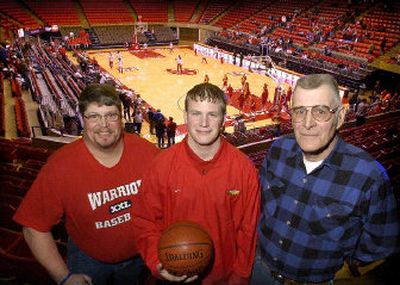
If this is the last State B Tournament – and it is, in feel if not fact – then it’s something of a comfort to know there’s a Bannish in it. And a Leifer. A Nilson, a Flett, a Hull.
The B is for bloodlines, the same names guiding you to Spokane each March.
And then there’s the Mills family of St. John, which seems to have a standing date here every generation.
At least until next year, when the B gets split in two by enrollment figures – the smaller schools (including those in Whitman County) staging their new 1B tournament in Yakima, the larger schools coming to Spokane for the 2B. For the farming and logging towns of rural Washington, this is a traumatic breach of tradition and nowhere is it being mourned quite so loudly as in St. John, where the trip to Spokane is seen as something of a birthright passed from father to son – and sometimes to grandson.
Of course, it isn’t so much that Mills men have all played in the B because, as each of them admits, they didn’t – or won’t – play all that much.
Being on good teams can mean understudying great players; from grandfather to grandson this is not at all a sore point and even a source of humor. For instance, at St. John-Endicott’s district championship game the other evening, a photographer told Kevin Mills he’d like to get some pictures of him in action.
“You’ll have to wait until we’re up 30,” Kevin advised with a smile.
Besides, even if the B thread connecting Dan Mills (1960), son Dale (1980) and grandson Kevin (2006) is participation, the bond is appreciation.
And it turns out great-granddad can take credit for that.
Asa Mills was a third generation Whitman County farmer. His grandfather, Aaron, arrived in Oakesdale in 1889 on the train from Missouri, and shortly thereafter homesteaded at Sunset. Asa, it’s been said, was a pretty good ballplayer, though he never played in the B – but only because there wasn’t such a thing yet. In 1930, he was on the Endicott team that placed fifth in the one-class state tournament in Seattle; brother Woodrow would play in the inaugural State B the next year.
Asa sustained crushed vertebrae in a farming accident in 1952 and took up driving a bus for the St. John school district. But no matter what his job, his avocation was the State B.
“My grandfather was just a fanatic,” said Dale Mills. “Starting with me in the fourth grade, the big thing for us kids was, when state tournament time rolled around in Spokane, he loaded us boys up – the three grandsons – and we’d spend all day Wednesday up there, all day long. One of the deals was, our grades had to be good enough – if you were failing any subject, you didn’t get to go.
“But we’d sit in the same place every year in the old barn – just to the right of the end of the bench almost to the horseshoe, in the first concourse. And we’d watch every game.”
And Dad wasn’t asked to the party?
“Oh, several times,” Dan remembered. “But I was trying to put beans on the table and couldn’t just pack up and go. And anyway, I always felt that was for Dad and the boys. It was their day.”
The lineup would change depending on circumstances – Dale playing in 1980, the grandsons tied up with their own jobs and family. In Asa’s later years, Dale and younger brother Michael resumed their trips to Spokane with their grandfather until he passed away in 1979.
“Then we let it slide for a few years,” Dale said. “But the last year of the old Coliseum, my brother and I decided to go and we’ve met up every year since. I’ve started taking my three kids and I’ve talked my dad into going with us. It’s a little corny, but it’s how I stay in touch with my roots.
“Some of the most vivid memories I have of my grandfather revolve around basketball.”
This is what matters to the Mills as much as their own participation – and Dale played on a state championship team, Dan on one that lost in the semis.
There are a handful of little communities with long tournament pedigrees – Reardan, Naselle, Darrington, Brewster, Morton, Menlo – but none holds to its B-ness as fiercely as St. John. Maybe it’s the seven titles and the 29 trophies, or maybe it’s because those roots are buried a little deeper – and are almost hopelessly entangled.
The Leifer in this year’s tournament? Brent’s cousins and uncles played in the 1980s and 1960s, but his grandfather was the legendary Irv Leifer, who starred for both St. John and Pine City in the all-class tournament. And the cousins? Their great-grandmother was actually a Mills, a sister to Dan’s grandfather Horace.
So, too, were current SJE coach Mike Tollett’s great-grandfather and Dan Mills’ grandmother, brother and sister.
“You get into these small towns,” cracked Dale, “and we’re all a bunch of inbreds.”
But you can understand how change doesn’t sit well – even with the younger set.
“Kids grow up wanting to go to state in Spokane,” said Kevin. “I’ve dreamed about it since I was old enough to remember.”
Heck, Dan even mourns the demolition of “the old Boone Street Barn. If they’d left it standing for a few more years, I would have played in it, Dale would have played in it and Kevin would have played in it.”
And aiming for state in Yakima?
“Not having the State B in Spokane,” offered Dan, “is like having a hamburger without ketchup.”
The arguments of equity and fairness – giving a small B school the same mathematical chance to reach state as, say, a 1A or 2A team – aren’t dismissed out of hand by the St. John people, and in time they’ll probably accept that “going to state is still going to state,” as Dale said.
“But right now, there’s a part of me that’s going to be lost and that’s true with a lot of people,” he said. “The tournament’s been (in Spokane) since, what, 1958? The simple fact is, going to Yakima is not going to be the same.
“Can you put a value on tradition? I can’t.”