
Measure of pawn
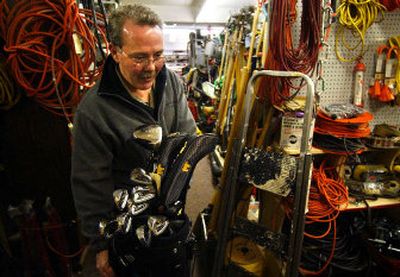

Twenty thousand times a month, something is hocked in Spokane County: a bicycle, a handsaw, a sweetheart’s necklace, a handgun.
As one pawnbroker’s phonebook ad reads, “If it doesn’t eat and it can fit through the door, we just might make you a loan for it.” And Spokane as a community seems to be taking that offer seriously.
Compared to other Washington counties, Spokane County’s number of pawn transactions is extremely high. This community, through 30 pawnshops, hocks as much stuff as Tacoma-centered Pierce County, which has 310,000 more residents and surpasses by nearly three times the pawn activity of the Washington county that most closely resembles Spokane, Vancouver-based Clark County.
The rate of transactions requires three community policing volunteers to keep up with. One of those volunteers, John Baldwin of Spokane Valley, says he’s seen it all.
“Last week someone pawned a wheelchair,” Baldwin said. Each morning he sits in front of a computer at Spokane Valley Police precinct scanning the records submitted by area pawnshops. Meticulously, he records every item pawned and matches the name of the person pawning to an extensive database of people who pawn. “There! We got a fly rod. Hope it isn’t mine.”
If you have pawned anything in the last four years police know about it because of volunteers like Baldwin. What they don’t know is what drives the pawn rate of the greater Spokane community. Some say it’s crime. Some say the reason is poverty.
Neither police nor pawnbrokers are trying to make sense of the volume of pawn activity, aside from two simple truths. People pawn. Some of the items pawned are stolen.
“I’ve always taken issue with the amount of attention (police) give to pawnshops,” said Larry Karlson, owner of Axel’s Pawnshop. “One out of every thousand items, we’ll get a hit.”
In a typical scenario, Karlson said the person pawning the stolen item is likely a relative, girlfriend or roommate of the victim. The victim comes into the shop searching for his stolen items, which unless he happens to have some serial numbers, are virtually impossible to identify. Karlson usually offers to search his computer for the name of friends or relatives of the victim, to see if they’ve been in lately, which isn’t to say criminals don’t attempt to launder stolen items through pawnshops on a grander scale.
Pawn data recorded at Axel’s two years ago led to the discovery of $9,000 in tools and bins of stolen jewelry at a Spokane Valley home.
Sheriff’s detectives unraveled the case by matching one serial number from a pawn report with a theft report from a woman who was ripped off by her niece. Gary Singer, of Dutch’s Pawn in downtown Spokane, said many times people don’t want to get the law involved once they realize a family member victimized them.
“Of the transactions we get, the very few with ownership questions, overwhelmingly it’s a family member,” Singer said. “The police want nothing to do with those. Most parents don’t want to prosecute their children. Essentially, if you’re not going to prosecute, there’s no crime.”
Police say the number of stolen items cycling through pawnshops is surely greater than one in a thousand, but so few victims can provide the serial numbers needed to prove the items are theirs that pawnshop merchandise can’t be recovered. Every pawned item with a serial number is noted, but few victims have any idea what serial number is engraved on their stolen property.
“You’ve got to remind people that they need to write serial numbers down,” said Sgt. Craig Hogman of the Clark County Sheriff’s Office. Without serial numbers, the 89,660 pawn transactions reported in Clark County are virtually worthless, he said. Just 51,000 residents shy of Spokane County’s population, Clark County averages only 7,400 monthly pawn transactions.
In Spokane County, Sheriff’s Detective Mark Stewart said the number of hits on stolen pawned goods was good when pawnshops first started reporting electronically, but he thinks word got out and thieves stopped coming around.
“When we first got it going, all five Pawn Ones had an initial spike in recoveries,” Stewart said. “But that leveled off. The media got on it, so a lot of (pawn customers) knew about it. When the pawn data was new, I asked our people to send me notices when something was recovered, but they stopped after a while.”
When police mine pawn data, they try to match stolen serial numbers with what’s coming into the pawnshop, but they also look for frequent pawn customers, and customers who pawn at more than one pawnshop in an outing.
A person who lives in Cheney, where there are two pawnshops, but does all his pawning in Spokane, is probably up to something, Baldwin said. Pawning is a local thing. Typically people stick to the pawnshop close to where they live.
At Karlson’s shop, most of the people who come in are from the neighborhood. He knows them, sometimes knows their parents because pawning can be multigenerational. And Karlson rejects the notion that a repeat pawner is necessarily a criminal. If a guy, and typically pawners are guys between the ages of 25 and 35, needs a loan he may pawn some tools. Eighty-five percent of the time, that guy will be back for those tools within 120 days, Karlson said. The pawner will have to pay off the loan, plus an interest rate set by state law. A $50 loan after a month will cost a borrower $59.50, or $2.50 in interest plus a $7 preparation fee. Chances are, he’ll be back again, often hocking the same stuff he pawned before.
The majority of people who pawn aren’t criminals, Karlson said. Rather, they’re people in need of a small loan, too small to bother with a bank, perhaps, or a loan for which they have no credit.
Property crime reports for Spokane County seem to support the pawnbroker’s assertion, considering that property crimes, including theft and burglary, aren’t astronomically high compared to counties with similar characteristics. In counties with at least one city larger than 150,000 people, property crimes are typically committed about 53 times a year for every thousand residents. Spokane County experiences about 56.4 property crimes for every thousand residents, King County 55.5, and Pierce County 51.9 crimes.
The only exception is Clark County, where 43 property crimes are committed for every thousand people. The rates are collected by police and presented in the Uniform Crime Report published by the Washington Office of Financial Management, which does research for the governor and Legislature.
Yet Spokane County, less than two-thirds the size of Pierce County, paces the larger community in pawn transactions. Where Spokane County sets itself apart from other areas is its poverty level. Police and pawnbrokers alike point to poverty as a reason for Spokane’s pawn rate, which is an opinion backed by the U.S. Census.
The last time the federal government asked Spokane County residents about household income, nearly a third, or 134,600 people, said they lived on less than $25,000 a year. That’s just 41,000 fewer people than much larger Pierce County and 62,000 more than slightly smaller Clark.
“It’s people who don’t have a line of credit who come in here. Over half our transactions are the same guys,” Singer said. “When you walk in here, you have to have an ID, a name and an address. A long-time police detective told me ‘a mature burglar is 15.’ Here, you have to be at least 18.”