
New night vision a welcome sight
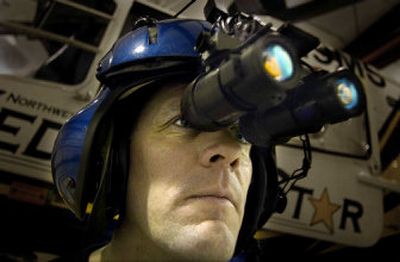
Northwest MedStar helicopter pilots are accustomed to flying the contours of the rugged Inland Northwest terrain on moonless nights to reach a rural heart attack patient or a victim of a remote highway accident.
Now, thanks to a costly investment in the latest night-vision technology, the pilots’ job has been made a lot easier. The difference, they say, is like night and day.
“It’s a little green window on a black, black world,” said pilot Chuck Booth.
MedStar crew members are being trained to use the top-of-the line Anvis-9 night-vision goggles, the same technology used by the U.S. military in Iraq. The Anvis-9 technology is so much more advanced than previous night-vision goggles that their distribution is controlled by the National Security Agency.
MedStar, a division of Inland Northwest Health Services, has bought nine goggles, manufactured by ITT Industries, at $10,500 a pair, said operations manager Steve Harris. Six of the helmet-mounted devices are for use in Spokane, and three are for MedStar’s base in the Tri-Cities.
But before crew members could begin using the night-vision equipment, which amplifies ambient light from dim light sources such as the moon or stars, modifications had to be made to reduce glare from the instrument panels of MedStar’s three EC-135 helicopters, at a cost of $25,000 each, Harris said. Factoring in training and fuel costs, MedStar’s bill for the technology came to about $400,000, he said.
It’s well worth the cost, said Chris Lindberg, lead pilot for Metro Aviation of Shreveport, La., which supplies MedStar’s flight crews based at Spokane’s Felts Field. A veteran pilot for the Marines and U.S. Navy, Lindberg is a fan of Anvis-9.
“It makes it so much easier to conduct missions,” he said.
Though MedStar’s helicopters are equipped with navigation-communication units that provide a visual display when the aircraft is within 500 feet of the ground, pilots depend almost entirely on their vision to avoid mountains and trees.
The human eye’s visual acuity at night is about 20/200 to 20/400, meaning it can clearly see at 20 feet what should normally be seen at 200 to 400 feet.
The Anvis-9 provides a visual acuity of 20/25.
Unlike previous models, the Anvis-9 does not create a blinding glare from bright lights seen through the goggles. The device does have limitations, however, including a 40-degree field of view, a two-dimensional image and a display in only shades of green. But Lindberg said he would choose the night-vision goggles with its green image over the unaided eye anytime.
“Once you’ve tried it, there’s no going back,” he said.
MedStar conducts 3,200 “flight operations” annually, Harris said. About 2,200 are helicopter flights, of which 30 percent are at night. The EC-135 flights, limited to about 110 miles, extend to northwestern Montana and the Canadian border. A crew comprises the pilot, a registered nurse and a respiratory therapist.
Aviation Specialties Inc. of Boise provided night-vision training, consisting of one day of ground school, plus five hours of flight time over three nights.
Between January 2002 and January 2005, there were 55 accidents nationwide involving emergency medical service aircraft, according to the National Transportation Safety Board. After an investigation of these accidents, which killed 55 people and injured 18, the agency made safety recommendations – among them the use of night vision.
The Federal Aviation Administration requires both the pilot and another emergency medical service crew member, typically the respiratory therapist, to wear the night-vision goggles upon takeoff and landing at night at unapproved landing sites, such as Highway 395 after an injury accident. The gear is not needed for flights between health care facilities.
Harris said MedStar flights will still be limited by weather considerations, such as wind, fog or extreme cold. But an added benefit of night vision is that it gives the pilot the ability to see fog banks rolling in from miles away.