
PMAC draws on creativity
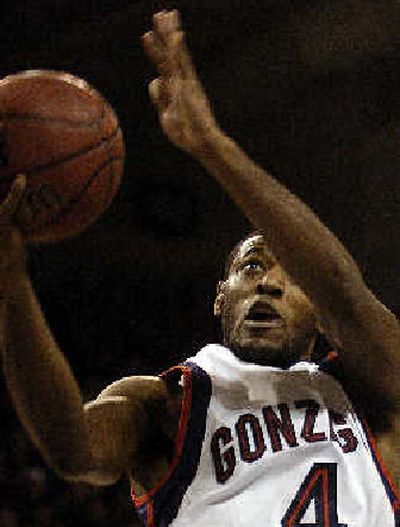
When he draws, Pierre Marie Altidor-Cespedes prefers the human form. Figures and faces.
Now, like any beginner he was at first “just trying to draw a nose that looks like a nose.” But as his gift grows little by little, he strives to expand on the elementary.
“I try,” he said, “to bring out the emotion of a moment.”
Really? Because in the bedlam that shook McCarthey Athletic Center on Monday night when Gonzaga preserved its perfect record there with a last-second victory over San Francisco, the figures and faces of Bulldogs basketball were aswirl in emotion and triumph. Adam Morrison sidewinding his way to the other end of the court, fist pumping furiously. Erroll Knight in full liftoff from the bench and halfway to the rafters. J.P. Batista in a constrictor’s embrace with the brother he didn’t think would be able to make the game all the way from Brazil.
But from the player who made the winning 3-point shot with a second left – Altidor-Cespedes – there was no over-the-top reaction. Maybe a little more flash in those remarkable eyes but little from the mouth, the mix an expression of detached puzzlement.
Then again, he’s the artist. What he did was bring out the emotion of the moment.
Wait. That may be a little presumptuous.
“I’m not an artist,” he insisted. “I like to draw. Usually, you don’t call yourself that. People that are respected in their art can call you that.”
The same holds true for “player.” It, too, is a distinction to be earned.
Not that this is a young man without distinction, and not just that of having what surely must be the longest name in college basketball – to the extreme that he is more familiarly known by the acronym “PMAC,” though you can call him Pierre.
But there are signs of late that Gonzaga’s sophomore guard is a player indeed – the cold-blooded 3 to beat USF, a 17-point breakthrough against Pepperdine, back-to-back games of five and six assists. Even another of GU’s great escapes – at San Diego early in the West Coast Conference season – doesn’t happen if Altidor-Cespedes doesn’t track down an offensive rebound to set up Knight’s heroic shot.
The work is still in progress, and progress can be fitful. To Altidor-Cespedes, it’s the nature of the game.
“People expect you to get better throughout the year, which is ideal,” he said. “But sometimes you might take a huge step one game and provide for your team in a way you haven’t before. Then maybe there’s a step back. I’m just glad I’m feeling more comfortable playing than I did last year. To me, that’s a very important thing.”
It’s just as important to the Zags heading into the postseason. With guard Derek Raivio struggling, there’s some urgency for production beyond the 1-2 punch of Morrison and Batista.
Altidor-Cespedes has always seemed able to provide it, but often has come off more reticent than willing. Earlier this season, coach Mark Few called him “my philosopher.”
“He probably means that sometimes when he tells me to do something, I’ll question it before I do it,” he said. “Not because I don’t agree. By questioning things, it makes you look at everything as a whole and once you see things as a whole, it’s easier to make the right decision.”
For instance?
“The obvious example is that they want me to shoot more. But the reason I didn’t shoot much last year is that we already had good shooters on the team. I wasn’t the guy to start shooting the ball. This year, it’s been a little of the same thing. If I get open looks and turn them down too often, it can be bad – my guy is going to slack off and our other guys well get double-teamed. But if I don’t shoot a shot, I don’t think I’m necessarily hurting the team.
“Scoring is one aspect of basketball. It’s not everything.”
This is a curious philosophy in today’s game, but PMAC is a curious case. He grew up in suburban Montreal, the son of a father who had emigrated from Haiti – the city’s Haitian community numbers more than 100,000 – and a mother who had come from Peru. He picked basketball – or basketball picked him – early, but he “usually played alone,” his friends interested only in hockey or soccer. A year at prep school under coach John Dangelas helped expose Altidor-Cespedes to U.S. recruiters when some Canadian players go wanting “because some other coaches don’t want them to leave the country,” he said. “They hide letters and the kid may never know he’s being recruited. That happens.”
He discovered GU during the Zags’ miraculous run to the NCAA Elite Eight in 1999, and picked them over Georgia and Xavier because he fell in love with the style of play.
One of his teachers, GU art professor Bob Gilmore, understands why.
“Improvisation,” he said. “That’s what ties him to the art. So much of basketball is improvisation. You’re not doing the same things every time. Every situation is different. You can draw up anything you want, but when you go out and play you have to be able to improvise.”
Gilmore is a long-time fan who is enamored of Altidor-Cespedes game – and more.
“I’ve been teaching here for 37 years,” he said, “and I don’t know anybody I’ve liked better than him. I think a lot of him as a person.”
And in the studio?
“Not bad,” Gilmore allowed. “Pierre’s pretty good in there.”
If he is not yet an artist, Altidor-Cespedes appreciates the craft of creation.
“It’s fun to think that you have a page that’s blank,” he said, “and a few hours later you have something that didn’t exist before.”
Not unlike a basketball game, with the ball in the air for the center jump.