
Many GM workers follow the jobs

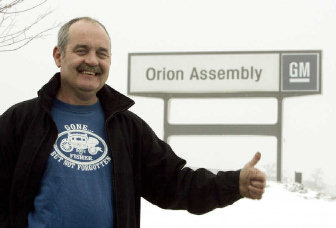
Tom Hoppe was raised the son of an autoworker, the great grandson of another. And when he graduated high school, it seemed natural Hoppe would join his classmates and find steady work on the production line, too.
But in recent years, Hoppe hasn’t so much held a steady job as chased a moving target.
As the world’s largest automaker has grown ever smaller — closing plants, cutting shifts and eliminating jobs — Hoppe has moved seven times from factory to factory, in pursuit of a paycheck and a pension.
Hoppe and thousands of workers like him call themselves “GM Gypsies.” And with General Motors Corp. and Ford Motor Co. set to close factories again, many of the workers who remain on board may well have to follow their migratory lead. But will there be enough jobs left for them?
“I’m always getting ready to leave. Some GM workers just keep their stuff in boxes,” says Hoppe, a 28-year GM veteran who expects his current job at a plant in Lake Orion, Mich. to be cut this spring when production is scaled back. “You never know.”
The uncertainty now built into a job on GM and Ford assembly lines was once all but unimaginable. Many GM Gypsies, and their Ford counterparts, are the sons and daughters of auto workers who toiled until retirement at a single plant and promised their children they’d be able to do the same.
“People looked at jobs in the auto plants like property, like something that they owned, something that could be passed down from father to sons,” said Gary Chaison, a professor of industrial relations at Clark University. “That was pretty much making it for a lot of people.”
That changed for good in the 1980s when GM, and Ford to a lesser extent, went through wrenching changes, closing plants and revamping manufacturing technology. In the past 20 years, GM and spun-off parts supplier Delphi Corp. have closed 110 plants (while opening 34 new ones) and eliminated more than 300,000 hourly jobs, mostly through attrition, said Sean McAlinden, chief economist with the Center for Automotive Research in Ann Arbor, Mich.
Workers hit the road to hold on to prized jobs. Over the past two decades, McAlinden estimates 80,000 GM production workers have moved at least 300 miles to take a new job with the automaker.
While such moves are common for white-collar workers, they have resulted in dramatic and sometimes uneasy changes for many production workers, uprooting families, stretching commutes to hours and causing tensions on assembly lines between transplants and oldtimers.
To ease the strain, the United Auto Workers union won benefits for workers whose jobs are eliminated, granting substantial incentives both to relocate for jobs in distant plants, as well as to stay put.
But the union’s contracts with GM and Ford expire in the fall of 2007, fueling widespread doubt about whether those benefits will remain intact.
Workers and labor experts expect the automakers to push to eliminate the “jobs bank” program that continues paying laid-off auto workers after their plants close.
Meanwhile, GM plans to cut 30,000 jobs by closing plants in cities like St. Louis and Oklahoma City where it has few nearby operations, focusing remaining manufacturing on its Midwest core. The closings and a new contract will likely force many of the workers at those plants to choose between hanging it up or relocating.
“There will be another burst of gypsy moves. GM will have to move another 20,000 to 30,000 in the next two to three years,” McAlinden said. “You’re really going to have to get a lot of these people to retire or move back to Michigan and Ohio.”
As GM moves forward with closings, it will try to convince older workers — the average GM production worker is just shy of 50 — to retire. That could lead up to 45,000 people to leave the automaker and create openings, McAlinden said.
But not all observers agree, noting that the unsettling shifts at work in the auto business make it difficult to predict what comes next.
The plant closings could severely limit the choices of many workers, eliminating their own jobs and creating increased uncertainty about the plants and jobs that remain, Chaison said.
“Not only will they (workers) be pushed by plant closings, but the closings will be so widespread that there won’t be anything pulling them to another job either,” Chaison said.
Hoppe says he expects to lose his current job in April, when the company plans slow production at his plant, setting the stage for a move to a ninth GM location.
The moves have had their pros and cons. Hoppe says the transitions strengthened his marriage because he and his wife grew to depend on each other. But since leaving Tennessee, he’s largely avoided forging friendships with co-workers, knowing he’s likely to be moving again.
He’s fairly confident he’ll make it to retirement with GM, given its remaining concentration of plants in Michigan. But that is where the family’s connections with GM will likely end, Hoppe says.
“I told my kids from a very young age that: ‘Don’t count on a job at General Motors because there won’t be one,”’ he says. “We really are at the end of the line.”