
McCartneys protest seal hunt

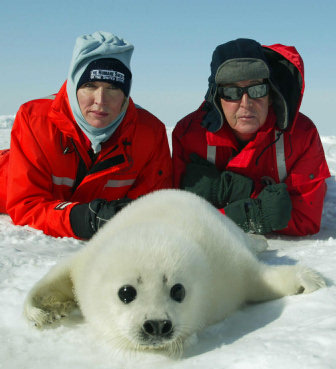
ON THE ICE FLOES IN THE GULF OF ST. LAWRENCE – Paul McCartney and his wife took to the frigid ice floes off the Atlantic Ocean on Thursday in a bid to halt Canada’s annual slaughter of weeks-old seal pups.
Animal rights activists contend the killing of the doe-eyed baby seals, who are often clubbed to death, pierced with boat hooks or skinned alive, is cruel and unnecessary, but fishermen say they badly need the income.
The McCartneys, dressed in orange thermal jumpsuits, traveled in helicopters with a dozen journalists, and members of the Humane Society of the United States and the British-based Respect for Animals.
Hundreds of seals and their fluffy white pups, only days old, were lolling on the ice in the Gulf of St. Lawrence, the mothers taking breaks from nursing to bob in the water to fish. The pups will shed their white fur within two weeks, when they become game for fishermen, who get up to $70 each for their pelts and blubber.
The former Beatle acknowledged residents have hunted seals for hundreds of years.
“Well, in our view, that doesn’t make it justifiable,” he said. “Plenty of things have been going on for a long time, like slavery. Just because it’s been going on for a long time doesn’t make it right.”
The McCartneys rolled on the ice with one pup, which gently nipped at Heather Mills McCartney and mewed for its mother. She expressed sadness it and others would likely be killed in a few weeks, their pelts going mostly to Norway, China and Russia.
“They sell the baby seal skins for fashions and fur – that’s what’s so horrific about it,” said Mills McCartney.
The former Beatle implored fishermen to turn instead to ecotourism like whale watching, as communities have done along the Atlantic Coast.
“This is one of the greatest wildlife spectacles on Earth,” he said. “It’s very rare that you can come to a beautiful, wild place like this. In our view, it would make more sense to look at ecotourism.”
Sealers say the hunt has kept their communities afloat for centuries.
“He’ll go out there and cuddle up to a whitecoat and they look beautiful, you can’t get away from that and it is cruel, you can’t get away from that either, but it’s something we’ve done for 500 years,” said Jack Troake, a 70-year-old sealer. “It’s helped to sustain us. We go to bed with a full stomach, a tight roof over our head. It’s part of our culture, our history.”
Roger Simon, manager of the Gulf of St. Lawrence seal hunt for the federal Fisheries and Oceans Canada, said the seals were not endangered and their population of 5 to 6 million animals was strong. He said some 15,000 fishermen, who earn an average of $30,000 to $40,000 a year, can each earn up to $10,000 during the two-week hunt.
“Now, Paul is making, what, $150 million a year?” Simon said. “I’m a lifetime Beatles fan. McCartney comes from a working-class background; you’d think he could maybe relate to the hardships of rural life.”
The United States has banned Canadian seal products since 1972 and the European Union banned white pelts in 1983.
The British government is also considering banning seal goods. Respect for Animals and the Humane Society of the United States, which coordinated the McCartneys’ visit, are encouraging a boycott of Canadian seafood.
“I think the McCartneys are two of the most visible people in the world, and with them drawing attention to the fact that this hunt is still going on, this is going to get that message out,” said Rebecca Aldworth, a Newfoundlander observing her seventh seal hunt for the Humane Society of the United States.