
The ultimate outsourcing
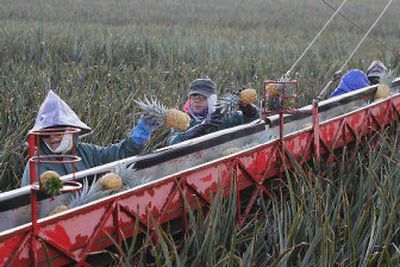
Kiyoshi Ikeda worked as a teenager in Hawaii’s pineapple fields for what was then a princely sum of $1 an hour. It was a good job with hefty benefits, he recalls six decades later. There was health care, education, the works.
“Prenatal to long-term care was established in the plantations in order to maintain a healthy labor force,” he says. “Even when the workers became unionized, the owners and the managers were willing to maintain reasonable cost supports.”
Not anymore. Del Monte has announced it will stop growing pineapples in Hawaii because the fruit is being grown more cheaply overseas — places like Costa Rica and the Philippines. And so, the fruit that had become a symbol of Hawaii itself is being outsourced. About 700 workers are expected to lose their jobs.
The news, while startling, is hardly unexpected. Farm jobs have been leaving Hawaii for years “because the only way you can do global business is to go to a cheaper place,” says Ikeda, now 77 and a professor emeritus of sociology at the University of Hawaii.
But while Hawaii has exported its jobs, growing techniques and farm technology, those exports don’t include the benefits that came with its farm work — the pensions, the health care, the schools for workers’ children — all negotiated by organized labor in the 1940s, Ikeda says.
Big U.S. companies “exported the capital improvements and technology, but they did not export the social technology,” he says. They seek “cheap labor with few protections.”
Paradise lost?
What happens to a place when it loses a product that defines it?
The very image of fresh succulent pineapple — its juicy sweetness, its sunny hue — dovetails with Hawaii’s view of itself as a sunkissed beach paradise. Dole says it will keep growing the fruit in the state even though it’s expensive, so a Hawaiian icon is safe for now.
But image isn’t always the truth. For starters, pineapples aren’t native to Hawaii. They were imported from the Caribbean and South America by the big fruit companies that went to Hawaii seeking — what else — cheap labor.
The pineapple “was never really part of early Hawaiian food,” says Andrew F. Smith, a teacher of culinary history at the New York’s New School University.
“It’s a stereotype. We make that association because there’s a commercial company — Dole, in particular — that went out and promoted that. They sent out advertisements and they set up this image, and we all believed it.”
That said, there are what Smith calls artisanal food products that can’t be separated from the place they are from. In France, for example, champagne must be from the Champagne region. Otherwise it can’t be called champagne. This is France’s stand against globalization.
But U.S. companies have traditionally rejected tying a product to its place of origin, which is why we have “California Champagne,” not to mention parmesan cheese that isn’t from Parma, Italy, and so on.
In Smith’s view, though, Americans are slowly coming around to the view that certain products are crafted using ingredients that taste a certain way because of the soil and climate and traditions of a specific place. There are people who seek out New York Finger Lakes wines, for example, or Washington State apples, New Jersey tomatoes, Monterey Jack cheese.
Wines, in particular, are labeled with their place names. “You do have a huge wine industry that’s developing here, and I think that’s an example where I think it’s in America’s interests to actually define products in terms of the location in which they were grown or made,” Smith says.
But not pineapples, he adds. “It has nothing to do with the real life of Hawaiians.”
Full circle
Globalization giveth, and it taketh away. “Globalization emerged very early in Hawaii because the markets for both sugar and pineapple were global in character,” says Ikeda. Not only was the fruit sold outside of Hawaii, but many of the plantation workers came from Japan and China.
Hawaii’s newest migrants are from the Philippines, where the relatives of current workers are the ones growing the fruit more cheaply, he says.
It’s all interconnected — remittances home by foreign workers help build those societies, he says. Pineapple-growing technology developed in Hawaii was exported back to Caribbean and South America. And, just maybe, the negotiated worker benefits that transformed Hawaii into a more democratic place can also be exported in the global marketplace of ideas.
“If people really want something to go right, they really need to organize and get together,” Ikeda says. “Hopefully, the Del Monte workers — even with the global transformation — the majority of them will make a very solid transformation. I’m optimistic.”