
U.S.-India nuclear deal raises doubts

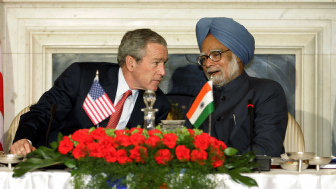
NEW DELHI – A landmark nuclear pact reached Thursday by President Bush and Indian Prime Minister Manmohan Singh faced tough scrutiny by Congress and international regulators amid concerns that it would allow India to expand its nuclear arsenal by hundreds of weapons.
If approved by Congress, the accord would recognize India as a nuclear military power and herald a major expansion in ties between the world’s largest democracy and the United States after decades of strained relations.
“What this agreement says is things change. Times change,” Bush said, appearing with Singh at Hyderabad House, the Indian government’s guest residence.
“We have made history today, and I thank you,” Singh said.
Some U.S. lawmakers and many arms-control experts said the pact would undercut the global system designed to halt the spread of nuclear arms, making it harder to rein in suspected Iranian and North Korean nuclear weapons programs.
Rep. Edward Markey, D-Mass., a co-sponsor of bipartisan legislation that would block the deal, said it made a mockery of the cornerstone of the system, the Nuclear Non-Proliferation Treaty, which India never signed.
“With one simple move the president has blown a hole in the nuclear rules that the entire world has been playing by,” Markey said. “It empowers the hawks in every rogue nation to put their nuclear weapons plans on steroids.”
While welcoming the accord, several senior Republican lawmakers, including Rep. Henry Hyde, R-Ill., chairman of the House International Relations Committee, said they would give it a rigorous review.
The accord also will have to pass muster with the 45-nation Nuclear Suppliers Group. It was formed to regulate civilian nuclear trade after India detonated a device in 1974 using plutonium obtained from a Canadian-made civilian reactor that was supplied with heavy water by the United States.
The group decides matters by consensus. Several members expressed misgivings with the India-U.S. agreement.
The accord would end India’s status as a nuclear renegade and clear the way for U.S. companies to sell civilian nuclear equipment to India. In return, India would declare 14 of 22 reactors part of its civilian program and place them under international monitoring.
Bush said Americans would benefit because increased use of nuclear power in India would reduce global demand for oil.
“Our Congress has got to understand that it’s in our economic interest that India have a nuclear power industry,” Bush said.
In addition to approving the pact, Congress would have to pass legislation exempting India from a 1978 law banning nuclear trade with nations that conduct nuclear test explosions or don’t accept comprehensive safeguards laid out by the U.N. International Atomic Energy Agency.
The accord, however, excluded important parts of India’s nuclear program from safeguards.
Eight reactors wouldn’t be covered by the safeguards and could remain sources of plutonium for weapons. The facilities include several civilian power plants and a fast-breeder reactor that will produce large amounts of plutonium.
While many details of the agreement weren’t disclosed, experts said that safeguards also wouldn’t cover existing spent reactor fuel, which contains enough plutonium for more than 1,000 weapons, and a facility for enriching uranium, which also can be used to make nuclear weapons.
India has an estimated 50 to 60 nuclear warheads, according to a September report by the Natural Resources Defense Council, a U.S. arms-control group.