
Ireland, by bus

DUBLIN, Ireland – For centuries, the iconic images of Ireland were the shamrock, St. Patrick, the Blarney Stone.
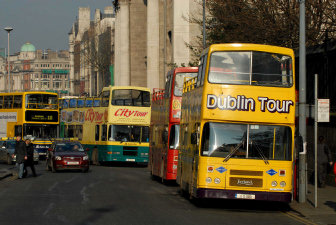
A more appropriate symbol of the Emerald Isle in the new millennium: the tour bus.
On a gorgeous morning outside the Waterford crystal factory, seven tour buses – “coaches,” as they’re known to the locals – awaited the scores of tourists wandering among the pricey product inside.
Hours later, as out-of-towners enjoyed lunch at local pubs, 10 buses were parked in the shadow of Kilkenny Castle.
Even on a quiet Sunday, when much of Ireland shuts down, three buses arrived rapidly outside the Connemara marble works – and it wasn’t even 10 a.m. yet.
The phenomenon led the Irish Times to run a series on the tour bus experiences of visiting Americans.
Clearly, bus tours of Ireland – from the spectacular vistas of the Ring of Kerry to guided trips along Dublin’s River Liffey – are increasing in popularity. That’s no surprise in a country where tourism is a multibillion dollar industry that provides 250,000 jobs and lures 6.5 million annual visitors.
And just as clearly, there’s good and bad in signing on with a busload of strangers for a motorized jaunt through the land of castles and churches – or anywhere else in Europe where the bus tour is an option.
Consider these things before letting the bus door slam behind you.
Hello, neighbor: One inescapable bus tour truth is the close and constant proximity to fellow travelers. You will spend plenty of time across the aisle from the childhood friends from Wisconsin, or the single mom from Oregon, or the folks on the family reunion from Florida and upstate New York.
You’ll pour them coffee at breakfast, pass the salt to them at lunch, break bread over dinner. If that’s too close for comfort with strangers, the bus tour is not your cup of tea (served simultaneously, with scones, to your entire tour group).
Leave the driving to us?: Around the Ring of Kerry, home to some of the most breathtaking scenery imaginable, the two-lane Irish roads are as narrow as a postcard view of the sights. There’s little margin for driving error in the mountainous region, where heather is more readily seen than guard rails.
Just riding on the tour bus can get nerve-racking. If you’re doing your own driving, expect even more trouble navigating around the huge buses (not to mention driving on the wrong side of the road). One guest at the Bunratty Castle Hotel confessed that he’d lost a hubcap on the impossibly cramped roads, only to hear from the rental car dealer that most folks lose at least two.
While gas is expensive in the U.S., it’s more than $7 a gallon in Ireland. That’s a consideration for rental car drivers, particularly those planning to travel extensively.
With or without you: The bus is an unforgiving beast that travels on its own schedule, with almost military precision. The itinerary is rarely flexible, particularly on days with a lot of driving. Spur-of-the-moment stops are impossible.
Feel like dawdling a bit in Killarney National Park? Not very likely with the driver waiting to reload the bus. Don’t forget, your “five minutes late” can hold up four dozen fellow passengers. That’s a lot of animosity to carry around with your luggage.
The real world: As a slave to the bus tour, it’s sometimes tough to distinguish between Ireland and Irish World, the Gaelic theme park where an endless parade of step dancers perform between countless renditions of “Danny Boy” and “Galway Bay.”
No, every pub doesn’t feature traditional music and dancing – it just seems that way at times. More typical might be an evening at Taylor’s Three Rock on the outskirts of Dublin, where the three-man band covered the Eagles and the parking lot attendant contributed a brilliant Neil Diamond impression.
Your host: The most important person on the tour is the one who’s staying behind – the bus driver/tour guide. The job, in addition to requiring top-notch driving abilities, carries a cornucopia of responsibilities.
The tour guide is comedian, shaman, historian, answer man. Few if any could pull it off in style like CIE International’s Ken O’Connell, a native of Limerick who seemed born to the bus.
“I’m only 22,” said the white-maned driver, soon to turn 51, after one harrowing stretch of mountain driving. “It’s the roads that gave me this hair color.”
His advice on the weather, in a brogue is as thick as the head on a well-poured pint of Guinness: “It doesn’t rain every day, but it’s rainy all the time.”
And: “Enjoy yourselves, because we may never pass this way again.” (Pause for effect.) “I mean, I will.”
You might, too. On a bus again? That’s another question.