
Raising morale
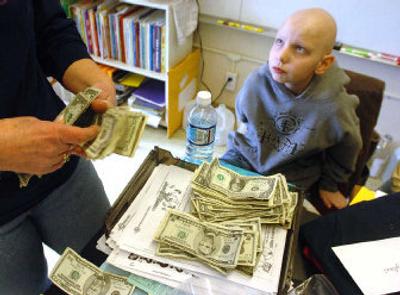
It looked like a piggy bank exploded in Kathy Zinkgraf’s fifth-grade classroom. Stacks of small bills piled up on the front table. Columns of quarters, dimes and nickels rose on every desk. Pounds of pennies filled the plastic bag the Freeman Elementary School teacher toted from student to student.
At the front of the room, 10-year-old Dylan Corbin watched weakly as his classmates conducted a lesson in basic addition – and community compassion.
For two weeks last month, students at the school south of Spokane pooled their pocket change and pestered their parents for donations to “Dollars for Dylan,” a fundraiser aimed at paying down massive medical debt for the boy who has leukemia.
At the urging of fellow student Felicia Jackson, youngsters set out milk jugs and plastic buckets, the better to catch every cent. On the day of the final tally, Dylan and his mother, Kim Kirkland Corbin, showed up to watch.
“In the first week – pardon me if I start to cry – they raised over $1,000,” said Corbin, 35.
By the time the students were through, the total had climbed to $1,831.27.
Realistically, that’s not even enough to cover two days of a single medication Dylan needs to battle a lung fungus related to his illness, his mother said.
But for the Corbins and others facing mounting medical bills, every little bit helps. Across the Inland Northwest, families stricken with illness, accident or other calamity often turn to spaghetti dinners, pancake breakfasts and garage sales to pay escalating costs for needs ranging from prosthetic limbs to heart transplants.
To some social service advocates, this is no way to run a national health care system.
“We feel that community members should not have to do that,” said Leo Morales, an organizer for the Idaho Community Action Agency, which monitors medical debt. “We live in the richest country in the world, yet in some cases we live in Third World conditions.”
Many families of injured people agreed. But many also said that small community events are a valid way to raise significant funds for urgent needs. Even more important, the grass-roots events spark human connections that benefit those who give as much as those who receive, said Dr. Jim Shaw, an ethicist at Sacred Heart Medical Center in Spokane.
“It seems like a brownie sale or kids getting their pennies together is just a drop in the bucket,” Shaw said. “The lemonade stand fundraisers aren’t going to solve the big issues for society. But they speak volumes about who we are as human beings.”
Just ask Nan-C-Lee Pukitis, who spent the past seven months in Spokane, waiting for her 49-year-old husband, Bob, to heal after a heart transplant at Sacred Heart Medical Center. The auto dealership worker from Burien, Wash., suffered a massive heart attack while camping in Colville last summer. Since then, he has exceeded a lifetime insurance cap of $2 million – and still the bills keep coming. Friends and family have raised more than $20,000 through efforts ranging from a spaghetti feed to workplace change jars.
“It shouldn’t be a community that helps you pay your medical bills, that helps you keep your home,” said Pukitis, 49. “But I learned something through all of this: People want to give. My sister said to me, ‘Say thank you.’ ”
No question, increasing numbers of people here and across the country have been forced to learn the same lesson. In the United States, health care costs are growing annually at more that four times the rate of inflation, according to the National Coalition on Health Care.
About 16 percent of the national population has no health insurance – some 45.8 million people in 2004 – according to U.S. Census figures. Last year, more than 15 percent of residents in Idaho and 13 percent in Washington lacked health insurance.
In North Idaho, nearly 1,300 people last year sought help through the Kootenai County Assistance fund, part of a state-financed system to provide relief to medically indigent clients.
“It’s usually someone ending up in the hospital who can’t pay the bill because they don’t have insurance,” Director Marla Lewis said.
Those who accept assistance have liens attached to their property – homes, cars and other assets – until they repay the debt, officials said.
“We feel like it just drives them deeper into the hole,” said Morales, of the community action agency.
For many, that means bankruptcy. About half of all bankruptcies filed in the United States are attributed to medical causes, according to a 2005 study by a Harvard Medical School professor and others.
In the Inland Northwest, that contributes to a personal bankruptcy rate that ranked Idaho 12th highest and Washington 18th highest in the nation in 2004, according to the Federal Deposit Insurance Corporation.
Grim as those statistics are in the aggregate, they’re even worse one at a time, said Capt. Gary Mobbs of the Hauser Fire Station. For the past 20 years, Mobbs and his 22-member volunteer crew have reviewed the plights of dozens of sick children for an annual benefit, Shalena’s Breakfast with Santa.
Held in December, the community breakfast typically raises about $5,000 for a North Idaho child with cancer. It’s named after Mobbs’ daughter, who died of the disease.
Over the years, Mobbs, 45, has seen a change in the kinds of kids and families they help.
“There seem to be a lot more single moms dealing with this,” he said.
With only one parent in the picture, many families are poorer, he said. Some parents have to quit their jobs to care for the children. Families may not have enough health insurance, if any.
“Even if insurance pays 100 percent, there are so many hidden costs,” Mobbs said. “They have to go to and from the hospital, you’re eating out all the time, staying out of town all the time.”
Add in ordinary bills and even the most solvent families can face catastrophe, said Angela Howell, 41, of Spokane Valley. Her daughter Shiri, now 18, was a champion motocross rider when she was seriously injured in a 2004 collision.
“If people lose everything, they could be living on the street after a major accident,” she said.
Howell still hasn’t totaled the cost of Shiri’s care, which was mostly covered through insurance. But she remains grateful for the $40,000 raised by the motocross community and another $3,000 generated by Shiri’s East Valley High School classmates, who sold green rubber bracelets in the girl’s honor.
“I think it just made them feel like they were helping in some way to help her get better,” she said. “I think it helped them feel like they were doing something.”
Bracelet sales, penny drives and pancake breakfasts are only a few of the varied efforts to generate funds for serious medical problems. In February, a belly-dancing group held a demonstration and dinner for a Coeur d’Alene woman who needed heart surgery. Last year, the Kootenai Electric Cooperative’s Operation Round-Up fund used spare change from customers’ power bills to help one user pay for a prosthetic eye, said Erika Neff, communications coordinator.
This year, part of the $18,000 annual fund will pay for an FM transmitter system that will allow 3-year-old Kimberly Hunt, of Athol, to hear better. The child, who was likely born deaf, had cochlear implants last summer, said her mother, Karen Hunt, 42.
“The implants were covered; each surgery was about $40,000,” she said. “But the FM system was not considered a necessity. It cost $2,500.”
The Round-Up fund will cover it, said Hunt, who receives insurance through her ex-husband’s job and federal Medicaid funds.
Hunt is grateful for the assistance, but she wishes parents didn’t have to scrounge for cash to pay for vital devices for their kids.
“I think we should go with socialized medicine,” she said. “I think it makes it more fair. Of course, the quality of care might diminish for some, but it would be more sharing.”
For people mired in the midst of calamitous medical problems, overhauling the national health care system is not a priority. Instead, their focus narrows to a single point: survival.
“When it rains, it rains,” said Nan-C-Lee Pukitis.
If a fundraising Web site can raise cash to pay for her husband’s medications next month, good, said Pukitis. If friends and family want to sell plates of pasta to help, she’ll let them.
“The fact that they stepped up to do this was amazing to us,” she said. “You never really realize how many people know you or how many lives you’ve touched.”