
Volunteers of all stripes cleaning up New Orleans

NEW ORLEANS – Standing on a median strip on the corner of a busy thoroughfare, homemaker Becky Zaheri addresses a band of volunteers, clad in orange safety vests, with the zeal and authority of an Army sergeant.
“Bag everything you can bag, and what you can’t bag, sort it and stack it in neat piles to be picked up,” Zaheri, 38, tells the group, which listens intently over rows of rakes, shovels, brooms and garbage bags in the glare of the morning sun. “Put all bags on the curbside corners, away from poles, posts and trees. Bring all supplies back with you at the end.”
The drill has become a ritual every Wednesday and Saturday, as Zaheri and her team – most of them newly acquainted – converge on a designated area of New Orleans to attack what many people consider its greatest enemy: trash.
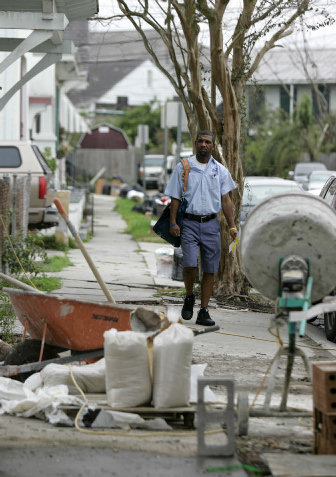
Armed with cleaning instruments, they begin to tackle the heaps of paper, cartons, blankets, tattered clothing, wood and rug remnants that still litter the city’s streets and median strips – referred to here as “neutral ground” – six months after Hurricane Katrina tore through.
Residents acknowledge that the city has always struggled with efficient garbage collection. But the local government has faced a myriad of other post-storm challenges, and only Friday kicked off a city-sponsored volunteer cleanup effort. Garbage has become New Orleans’ new emblem, and in many neighborhoods, more rubbish than cars line curbs.
“It’s going to take everyone who’s still left living here to get involved,” said Zaheri, whose trash force calls itself the Katrina Krewe and includes students, homemakers, retirees, teachers and other professionals.
As residents return home – Mayor C. Ray Nagin estimated that about 200,000 are back – they are gutting structures and tossing sheet rock, furniture parts and defunct appliances wherever there is space outside. Food, diapers, newspapers and other regular household waste is being mixed in with the larger storm debris.
According to the New Orleans Emergency Operations Center, storm debris removal is almost 56 percent complete, excluding refuse from the demolition of structures. And officials from the U.S. Environmental Protection Agency said that as of March 6, more than 11.5 million pounds of general waste had been collected and disposed.
Still, the magnitude of the trash appears to dwarf the official cleanup effort. That’s why Zaheri is urging residents to get involved.
“You can’t come back to your city and sit back,” said the mother of two young children, whose home in the city’s Uptown neighborhood was spared major Katrina damage. “Do you want to turn every corner and it’s a junkyard?”