
Hamas submits Cabinet list to Abbas
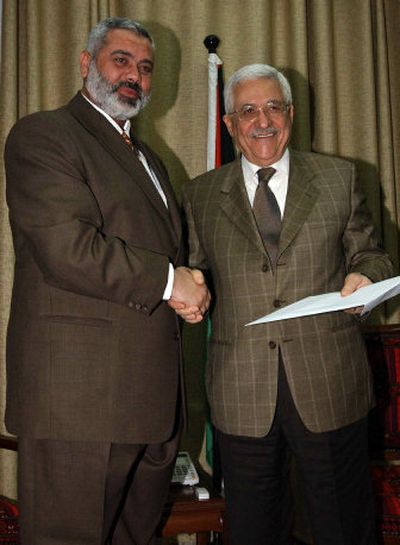

JERUSALEM – Hamas finalized a proposed Cabinet Sunday that would place several key ministries in the hands of senior leaders but not include any other Palestinian faction, precisely the narrowly partisan government that the radical Islamic movement had hoped to avoid.
Ismail Haniyeh, the designated prime minister, submitted the list Sunday evening to Palestinian leader Mahmoud Abbas, whose secular Fatah party declined to join the Cabinet. The Cabinet’s makeup will likely complicate efforts to convince international donors to continue funding the government once Hamas, designated a terrorist organization by the United States and European Union, assumes control of the ministries.
“Their task was to have as wide a government as possible with Fatah, other factions and independents,” said Ali Jarbawi, a political science professor at Beir Zeit University in the West Bank. “The Cabinet they have proposed will be, in effect, all Hamas. They are facing a deep problem.”
Also Sunday, the U.S. ambassador to Israel assembled Israeli and Palestinian delegations to discuss mounting humanitarian problems in the Gaza Strip resulting from closures of the main cargo passage with Israel. The Karni crossing has been shut for most of the year because of Israeli security concerns, but shortages of basic foods and medicine are beginning to threaten the welfare of Gaza’s 1.3 million residents.
Richard Jones, the U.S. ambassador, called the meeting in Tel Aviv on a few hours’ notice to salvage a U.S.-brokered agreement setting out the terms of operation at Karni following Israel’s withdrawal from Gaza last fall. In recent weeks, Israeli officials have made clear they want the Palestinians to begin using a southern passage at the intersection of Gaza, Israel and Egypt, far from the strip’s economic center in the north, rather than Karni.
Palestinian officials had refused, citing the terms of the agreement. But the delegations decided Sunday to open the southern passage, known as Kerem Shalom, today for humanitarian deliveries from Egypt.
Haniyeh’s proposed Cabinet, which was due by the end of the month, could still change in the weeks ahead. Hamas will likely continue seeking partners to broaden its domestic support and assuage international donors, who supply nearly half of the Palestinian Authority’s $2.3 billion annual budget.
Abbas has demanded that Hamas accept several signed agreements backed by his Fatah party that would, in effect, amount to a recognition of Israel. Although the Palestinian basic law does not give him the authority to veto the proposed Cabinet, Abbas could fire Haniyeh immediately after it is sworn in by the Hamas-dominated legislature elected in January.
Hamas leaders have so far refused Abbas’ demands and pledged to continue confronting Israel “by all means.” But Abbas’ aides have indicated in recent days that he will give Hamas a chance to run the ministries while working to persuade its leaders to endorse a negotiated two-state solution to the conflict.