
Basque separatists call end to violence

MADRID, Spain – The Basque separatist group ETA on Wednesday declared a “permanent” cease-fire and pledged to step away from decades of violence, a major breakthrough that could end Europe’s latest armed conflict.
The announcement came at a time of military and political weakness for the militant organization that has fought for independence from Spain for nearly 40 years and claimed hundreds of victims in bombings and sabotage.
It follows a fierce crackdown under the previous Spanish government and a period of rumored negotiation, officially denied, with the current one. ETA has also seen its popular support fade amid public outrage over deadly bombings in Madrid two years ago by Islamic radicals.
“This is very good news for all Spaniards,” Vice President Maria Teresa Fernandez de la Vega said as first reports of the truce swept the country. Urging “prudence,” she added: “We very much hope this is the beginning of the end.”
Reactions cleaved along political lines in this bitterly polarized country. While the Socialist government of Prime Minister Jose Luis Rodriguez Zapatero responded with cautious elation, the conservative opposition noted that ETA’s move fell short of surrender and was therefore nothing more than a ruse. Ordinary Spaniards were full of tentative hope.
ETA declared the cease-fire, effective Friday, through a videotaped statement released around midday and broadcast on Basque and Spanish television. Unlike two previous cease-fires that collapsed after several months of negotiations, this declaration uses the term “permanent,” and makes no conditions.
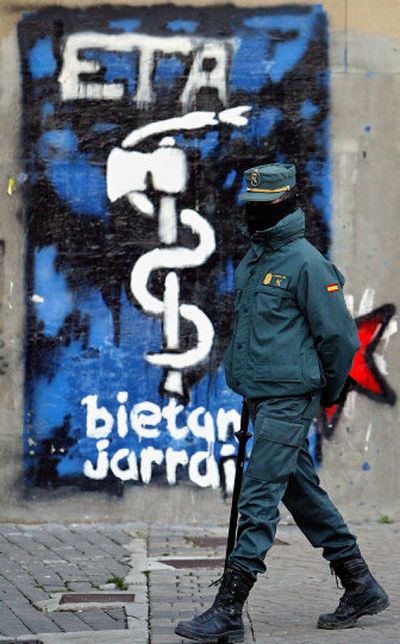
In the announcement, three members of the guerrilla group, wearing white masks and the black berets typical of Basque country, sit at a table bearing the words Euskal Herria, a reference in Basque to a greater Basque homeland. Behind them hung a banner with the ETA insignia of a snake twisted around a hatchet. The statement was read, unusually, by a woman, who sat in the middle.
“ETA has shown its desire and will that the process now begun should reach a conclusion and thus achieve true democracy in the Basque country, overcoming long years of violence and constructing a peace based on justice,” the statement said.
ETA – the initials are an acronym for Basque Homeland and Freedom in the Basque language – has declared cease-fires in 1989 and 1998, but negotiations that followed collapsed. This announcement may be different, analysts say, after the arrest and imprisonment of senior leaders, the capture of a major arsenal and the banning from politics of its political wing. Opinion polls have shown a widening weariness of violence in the Basque country.