
Program puts higher education in reach

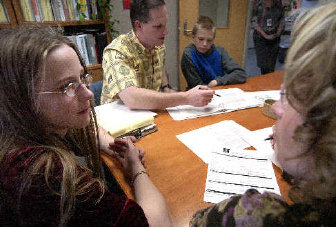
At Andrew Bowerson’s age, everybody who wants to be an astronaut gets to be an astronaut – or in the 13-year-old’s case, an FBI agent – when they grow up. At least that’s what parents and teachers tell their children, that life is an open book with pages yet to be written.
But Pam Francis, Andrew’s principal at Centennial Middle School, knows the chapters of the seventh-grader’s life being written right now can dramatically affect the outcome. Whenever the teenager skips to the happy ending, Francis brings him back to the chapter he’s on now.
“And Andrew, what do you think you’ll have to do to work for the FBI” Francis asks, “Maybe go to college?”
“Yeah,” Andrew says. “You have to have a college degree.”
She is always bringing students back to the here and now, because studies show that in schools like this one, where half of the kids come from low-income households, college is a conversation that doesn’t come up much.
To get students and parents thinking about college, West Valley School District, of which Centennial is part, is rolling out an ambitious program to get students thinking about college as early as seventh grade.
The plan means getting middle school children to complete algebra studies before enrolling in high school. It also involves getting older students to apply and test for college enrollment long before graduation.
National studies indicate that in eighth grade, at a time when students should be preparing for college, only 58 percent of low-income students believe they’ll ever attain a four-year degree. Consequently, these students are less likely to enroll in the classes necessary to eventually become college eligible. The research is done by the National Center for Education Statistics, which identifies shortfalls in planning and expectation as bigger roadblocks to continued learning than college tuition costs.
Both the Washington and federal governments are giving school districts money to boost the college-bound number of low-income graduates. This month, West Valley School District received a $152,000 grant to provide long-term, year-round college preparation to students beginning in seventh grade. The money comes from a federal program known as GEAR UP, which stands for Gaining Early Awareness and Readiness for Undergraduate Programs.
Soon, the funding will provide students like Andrew with extensive tutoring and mentoring from teachers, college students and adult volunteers. And there are benchmarks along the way to make sure students have learned what they need for college by the time they’re seniors. The GEAR UP program is new to West Valley School District, but the statewide GEAR UP has been around since 1999.
“GEAR UP in the past six years really has a lot of success stories,” said Weiya Liang, who directs the program for the state Higher Education Coordinating Board.
As an added incentive, the Higher Education Coordinating Board is securing tuition money for GEAR UP students, using the same “college tomorrow at today’s prices” program that Washington parents use – the guaranteed education tuition program. The board invests $600,000 a year into the tuition program, a state organized tuition savings account, Liang said.
The board reports that 1,200 students annually have been served through the grants issued through its office. More than 82 percent of GEAR UP students complete algebra by ninth grade, and at least 75 percent of Washington’s early GEAR UP graduates have enrolled in college. The last statistic represents a substantial leap over the national average for college enrollment by students from low-income families.
Officials with the federal Education Department report that only 58 percent of students from low-income families expect schooling of any kind once they graduate from high school. On the other hand, more than 73 percent of students from middle-income families expect to attend and 92 percent of students from high-income families say they will attend a four-year school.
At Centennial Middle School, Francis turns her students’ attention toward college on a daily basis. She wants Andrew Bowerson and others to see college as the next step and to know how to get there because once low-income students enroll in college, the difference in academic outcome between them and their more affluent peers is almost insignificant.
GEAR UP funding, for Washington school districts with large numbers of low-income students, is secure at least until 2011. The program hasn’t been included in President George W. Bush’s proposed federal budget for several years now, but every year Congress amends money into the budget for GEAR UP. The current funding agreement means GEAR UP will be there at least a year after Andrew graduates.
Already, the principal and student are talking about college as a key to more than even an FBI career. “Why else do you want to go to college?” the principal asked.
“I want a good house,” Bowerson said. “I want a good job and a good life for my family.”