
One trip and you’ll be hooked
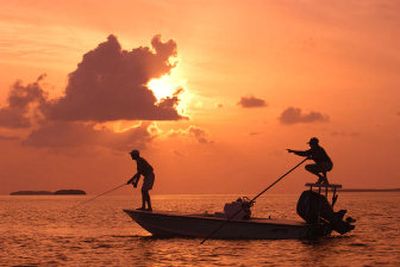
OFF THE FLORIDA KEYS – Serenity turns to chaos in the blink of an eye on the Catch-22 when the fishermen find the target of their search – a school of hungry fish gathered around a floating chunk of seaweed about 30 miles from shore.
In goes the bait, and out of the flat, azure waters come the dolphin fish – not the lovable “Flipper” types but yellow, green and blue fish, flapping frantically until they are put in ice in the live well of Richard Stanczyk’s boat.
Blood and bait pieces are cleaned before the next round, when the catch includes triple tails, rainbow runners, and even some unwelcome barracudas.
It’s a common scene all year in the Florida Keys, the chain of small islands stretching like a wagging tail from the southern Florida Peninsula.
Among the most popular destinations is Islamorada, which, like much of the Keys, attracts tourists year-round with warm weather and furious fishing.
“There’s something special about being out there on the blue water and the sun and the air,” says Stanczyk, owner of Bud n’ Mary’s marina on Islamorada. “It’s something an average guy can do off the Keys, with a little luck.”
On the Atlantic Ocean side of the Keys, a coral reef provides anglers with opportunities for snapper, amberjack, and grouper, while the deep waters farther out in the Atlantic are grounds for dolphin fish, sailfish, swordfish and sharks.
The western side of the island chain offers backcountry and flats fishing for bonefish, tarpon, permit, redfish, and snook.
“Only here and Kenya have such a wide mix of fish,” said Graeme Pullen, a sportsfishing writer from Fleet, England, while aboard the Catch 22. “They have so many species you can go for.”
The sportsfishing industry is both big fun and big business, creating revenue for everything from mom-and-pop bait shops to gas stations to chain hotels.
The island chain’s storied fishing history dates back to the late 1800s. A railroad stretching into the upper part of the island chain attracted anglers from farther north who had never seen such fertile and diverse fishing grounds.
Perhaps the greatest Keys fishing tale was the catch made off Knight’s Key by Capt. Charles Thompson in 1912. He battled a 38-foot-long whale shark for a reported 39 hours, harpooning it multiple times and riddling it with bullets. The 10-ton fish was then stuffed and mounted on a railroad car for a tour.
Today’s big-game anglers can partake in various offshore tournaments. Florida Keys Fishing Tournaments Inc. has a $685,000 budget to promote the sportsfishing industry in the Keys, and it uses the tournaments – including some women-only events – for sailfish, dolphin fish and other catches as hooks to attract tourists.
The high-end traveler will drop anywhere from $650 to more than $1,000 for a full day of fishing (half-day trips also are available) on a boat like Stanczyk’s 54-foot Catch 22, a multilevel custom job featuring outriggers, a wide fishing area in the stern, an air-conditioned cabin and the latest fish-finding technology.
The larger vessels are ideal for groups of four to eight people – corporate groups, families – who want to fish in deeper waters. Captains provide the fishing license, bait, tackle and expertise. Anglers bring their own refreshments, sunblock and seasickness medication (it can get wavy 40 miles out in the Atlantic). When you get back, you can have your catch cleaned to take with you.
Backwater and flats fishing is cheaper, with guides charging about $350 to $450 per day for two people aboard smaller boats.
Both options put the onus on the captains or guides to find the fish and provide personal attention to clients, giving them their money’s worth.
“If I had a person on this boat today who never held a fishing rod in their life, they still would have a great time,” Stanczyk said.
More economical options include party boats that charge about $50-$80 per person for several hours of offshore fishing. They are able to limit the cost because the trip is shared by several people, but there is less personal attention.
Another way to economize is to go in the summer, when hotel prices are lower but billfishing isn’t quite as good.
You can also fish off one of several bridges, but you have to provide your own bait, tackle and fishing license..
Back on the Catch 22, the lulls between rounds of fishing go by rather quickly. Some engage in conversation about politics or education, while the boat’s mate readies trolling lines in a search of sailfish.
Stanczyk sits back in his captain’s chair and talks about the difficulties of owning a business in the Keys and the struggle to keep a fishing business alive amid rising fuel costs, environmental restrictions, and big developers moving in with condominium plans.
But he smiles when he comes across the latest school of dolphin fish.
“This country works so hard, we need to play some, too,” Stanczyk said. “This is a unique place and a special place.”